
RESEARCH EXPLAINER / 24 OCTOBER 2026
A living power source has to do more than produce a voltage.
A voltage can be a useful observation. A working energy source must also deliver current to a load over time. That difference shapes the next Helios question: how much useful energy reaches the device, and which processes supplied it?
The mechanism
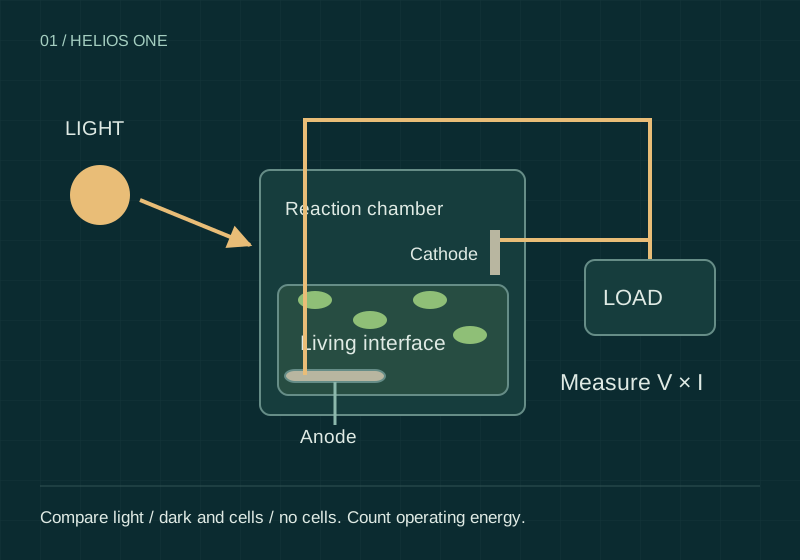
Living photosynthetic organisms offer one route for studying the conversion of light into electrical output. In a biophotovoltaic experiment, however, the measured signal can also include electrode chemistry and stored charge. A meaningful record therefore needs matched controls, a defined load and a clear system boundary.
The published foundation
A 2014 microfluidic biophotovoltaic study reported measurements with and without cyanobacterial cells. Its device illustrates why the comparison matters: the no-cell control also produced power. The paper also distinguishes electrode-area power from device-footprint power; those denominators cannot be exchanged.
Read the original manuscript ↗
The next question
The Helios brief proposes light/dark and biological/abiotic comparisons, time-resolved voltage and current, and accounting for auxiliary energy. The ambition is a useful living energy system. The next decision is grounded in what a defined load actually receives.
Read the full program brief ↗Matter Continuum editorial · AI-assisted synthesis · This is an explainer, not an announcement of a new experimental result.