
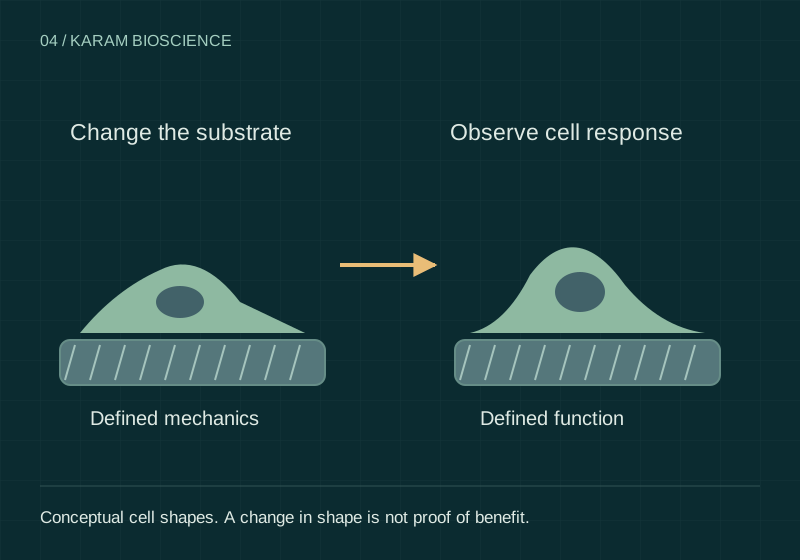
Mechanics, bioelectricity and function
Dupont and colleagues identified YAP/TAZ as mediators of mechanical signals associated with matrix rigidity and cell shape. That provides a scientific foundation for a mechanobiology study. It does not establish rejuvenation or a general benefit from electrical stimulation.
Original YAP/TAZ study ↗ · Publisher abstract and figure descriptions checked; full subscription text was not available.
Proposed record C1: a defined mechanical comparison
Choose one authenticated cell model and one physical variable. Specify substrate properties and surface chemistry, culture history, a primary functional endpoint, a mechanistic readout, viability and cell identity checks. A nuclear YAP measurement may support mechanism; it cannot substitute for the functional endpoint.
Use independent preparations as biological replicates, blind image analysis, predefine exclusions and account for clustering. Specify follow-up after the stimulus is removed if persistence is claimed. A failed function or viability criterion should prevent a positive marker result from being promoted as success.
Current scope
This is a proposed research direction; the cell model and exposure specification have not been locked here. Endogenous membrane-voltage networks, externally applied electric fields and mechanical substrates are different interventions. Each needs its own mechanism and controls. No clinical efficacy, human age reversal or treatment recommendation follows from these proposed experiments.
What a useful result could enable
A reproducible result could improve research assays and help identify mechanisms worth investigating. Clinical benefit requires separate evidence.
Published work provides context. The proposed tests on this page are not completed Matter Continuum results.