

The essential answer
Collection efficiency is meaningful only after its numerator and denominator are defined. A bottle-based efficiency compares recovered water with incoming liquid through a specified reference area and time. A single-fiber collision efficiency answers a narrower question and cannot automatically stand in for whole-device performance. Airflow diversion, missed collisions, surface retention, drainage, and evaporation can all separate incoming fog from bottle yield. Naming those stages makes apparently conflicting efficiency claims easier to compare fairly.
How to reason about it
A useful conceptual decomposition separates aerodynamic access, droplet capture, and drainage. Multiplying fractions can approximate overall performance if their definitions and reference flows are compatible; independence should not be assumed without checking. Wetting can alter airflow, and accumulated water can change the geometry that controls capture. The cited kirigami study discusses these component efficiencies. For an original bookkeeping model, draw one boundary around the entire device and another around its collecting elements. Record which boundary supplies the denominator. A projected frontal area and total material surface area are different quantities. A device that directs additional surrounding flow toward its collector may appear unusually efficient under a narrow area convention; that is a reason to inspect the control volume, not to discard conservation of mass.
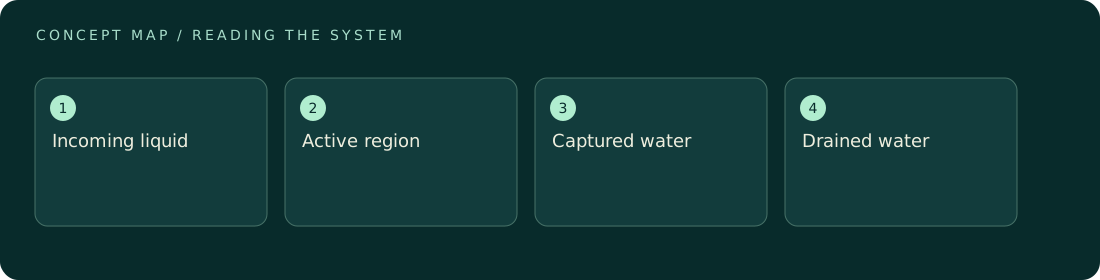
ILLUSTRATIVE · NOT A REPORTED RESULT
An example to work through
Assume 100 grams of liquid crosses a declared upstream reference area. Suppose 80 grams reaches the active region, half of that is captured, and three quarters of captured water reaches the bottle during the interval. Bottle recovery is 100 times 0.8 times 0.5 times 0.75, or 30 grams. Overall efficiency is 30%; the conditional capture fraction is 50%. Both numbers are correct for their stated denominators. The example assumes the stages can be multiplied and that there is no initial stored water contributing to drainage.
Where interpretation fails
Comparing 50% capture with 30% bottle recovery can make the poorer system appear superior when the metrics are different. Another trap is counting water drained after the event as if it arrived during the measurement interval. Define timing and initial surface storage alongside area.
The next decision
Require the numerator, denominator, area convention, averaging interval, and initial wetness before comparing efficiencies. When those details are unavailable, compare the reported quantity by its full name rather than ranking devices on a bare percentage. Use a mass balance to locate the missing stage.
Sources & context
These sources support the concepts noted below. Our synthetic examples and research framing are educational interpretation; they are not findings from these organizations or validation of our ventures.
- Kirigami fog nets: how strips improve water collection ↗
Aerodynamic, capture, and drainage efficiency decomposition.
Source check: Search-result abstract or official excerpt reviewed; full paper methods not audited
Educational research context, not a validated device specification or clinical protocol. Read our editorial and correction policy.