

The essential answer
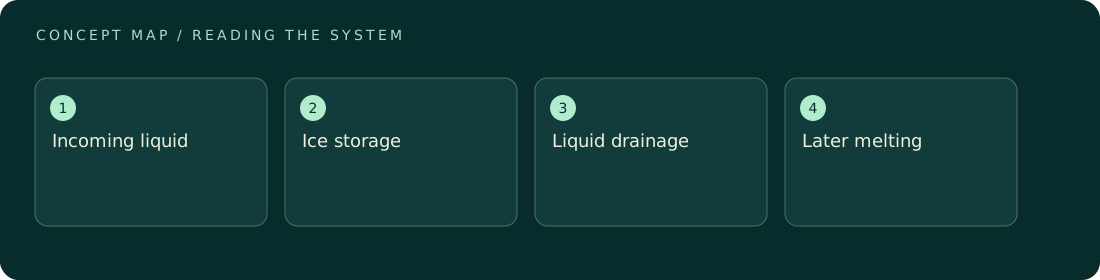
When liquid droplets freeze on a collector, the operating problem changes. Ice can alter shape, reduce open area, retain water that would otherwise drain, and increase loading. A bottle may show low yield even while substantial water accumulates on the structure. Conversely, later melting can produce bottle gain after incoming fog has stopped. Separate liquid collection, ice storage, and meltwater in time. This is a conceptual mass-and-heat accounting issue, not an aviation or deicing procedure.
How to reason about it
Supercooled liquid can remain unfrozen in air and freeze after impact, as NASA's icing overview explains. Whether incoming water freezes immediately depends on a heat balance and surface conditions, so air temperature alone does not determine every outcome. For a collector, freezing modifies both the material inventory and the flow geometry. A useful state description includes water entering, liquid draining, ice retained, and any melting or shedding. The energy needed to change phase belongs in an active system's energy boundary. Measurements should also identify whether a mass sensor includes the collector itself or only the bottle. Those two arrangements can report different trends during icing without either being wrong. The key is to keep storage terms visible instead of forcing all captured water into an instantaneous drainage efficiency.
ILLUSTRATIVE · NOT A REPORTED RESULT
An example to work through
Assume a hypothetical interval brings 100 grams of intercepted liquid to a collector. Of that, 60 grams freezes and remains attached, 30 grams drains, and 10 grams is retained as liquid. The accounted mass is 60 plus 30 plus 10, or 100 grams. Bottle-only recovery is 30%, while retained plus drained capture is 100% under these assumptions. If all stored water later drains, the bottle may gain another 70 grams during a fog-free period. This timing difference must not be called new atmospheric collection.
Where interpretation fails
Low bottle gain during freezing does not prove poor interception, and a large meltwater pulse does not prove exceptional fog supply. Ignoring ice storage also obscures changing blockage. Avoid transferring a warm, dry mesh's efficiency unchanged to a cold, iced configuration.
The next decision
Report phase and storage explicitly whenever freezing is plausible. Compare event-integrated water balances as well as instantaneous drainage, and document any heating energy. If ice accumulation is unmeasured, state that bottle recovery alone cannot determine total capture during that interval.
Sources & context
These sources support the concepts noted below. Our synthetic examples and research framing are educational interpretation; they are not findings from these organizations or validation of our ventures.
- NASA: In-flight icing basic physics ↗
Supercooled droplets and impact freezing; collector accounting is original conceptual reasoning.
Source check: Search-result abstract or official excerpt reviewed; full paper methods not audited
Educational research context, not a validated device specification or clinical protocol. Read our editorial and correction policy.