

The essential answer
Liquid water content, or LWC, is the mass of suspended liquid water per volume of air. It is a concentration, commonly expressed in grams per cubic meter, rather than the amount a collector will recover. To estimate available mass, multiply representative LWC by the air volume crossing a defined area. To estimate collected mass, additional capture and drainage factors are needed. A reliable calculation keeps vapor, suspended liquid, collected liquid, and residual surface water separate.
How to reason about it
LWC can be obtained from a size distribution by summing the liquid volume in each droplet class and multiplying by water density. That calculation magnifies diameter errors because droplet volume is cubic in diameter. Alternatively, instruments may infer water content from other observables, introducing calibration assumptions. The cited instrument comparison illustrates why different measurement principles need not agree perfectly. In a field record, attach location and averaging interval to every LWC value: one point can miss spatial gradients or a short burst. A concentration measured upstream is useful only if it represents the air entering the collector. Also distinguish liquid water content from liquid water path, which integrates concentration through a depth and therefore uses mass per area. Replacing one with the other silently changes the physical question.
ILLUSTRATIVE · NOT A REPORTED RESULT
An example to work through
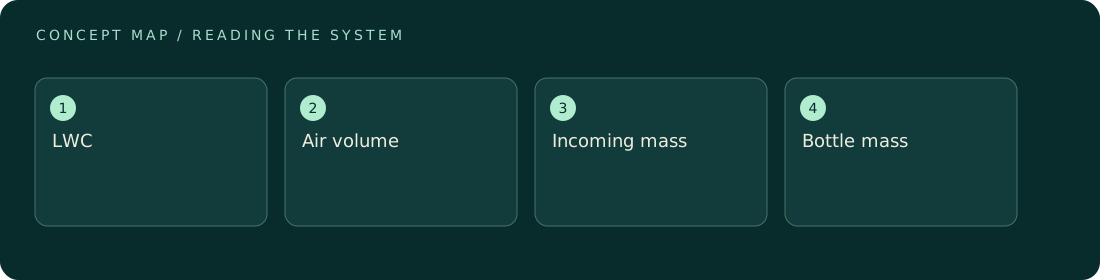
Assume uniform LWC of 0.15 grams per cubic meter and 240 cubic meters of air crossing the chosen inlet area during a test. Incoming suspended liquid is 0.15 times 240, or 36 grams. If an explicitly assumed overall recovery fraction is 0.25, predicted bottle gain is 9 grams, approximately 9 milliliters using water density of 1 gram per milliliter. The model excludes evaporation, rainfall, and changes in stored surface water. A different recovery fraction would change the bottle estimate without changing the incoming concentration.
Where interpretation fails
Reporting 0.15 grams per cubic meter as a collection rate leaves out both air throughput and time. Likewise, a high LWC reading next to a sprayer may describe a local plume rather than a field site. Always preserve the sampling geometry and units when using the value.
The next decision
Use LWC to define the incoming liquid inventory, then propagate uncertainty through airflow and recovery separately. If only a point measurement is available, label the estimate as conditional on spatial representativeness. This makes it possible to improve the weakest measurement without pretending the whole model is exact.
Sources & context
These sources support the concepts noted below. Our synthetic examples and research framing are educational interpretation; they are not findings from these organizations or validation of our ventures.
- Intercomparison of holographic imaging and forward light scattering measurements ↗
Different cloud-droplet measurement principles and LWC assessment.
Source check: Search-result abstract or official excerpt reviewed; full paper methods not audited
Educational research context, not a validated device specification or clinical protocol. Read our editorial and correction policy.