

The essential answer
Collecting atmospheric water does not by itself establish that the water is suitable to drink. Water quality depends on the air, collecting surfaces, storage, handling, and the substances or organisms being assessed. A conductivity or clarity reading cannot substitute for an appropriate analytical panel. Define the intended use and relevant local requirements, then use qualified testing support. This educational page explains evidence boundaries; it does not certify a collector, a treatment process, or any water sample.
How to reason about it
Quality is a set of measured properties rather than a single universal score. A laboratory result applies to specified analytes, methods, detection limits, and samples. A non-detect means the analyte was not detected above the method's reporting threshold in that sample; it does not prove absence of every possible contaminant. Storage can introduce a new exposure after collection, so the sampling location matters. EPA provides information on certified drinking-water laboratories and approved analytical methods in its jurisdiction. Elsewhere, the appropriate authority and requirements may differ. For a collector evaluation, keep production volume and quality conclusions in separate evidence tables. Record where the sample came from and what question each test answers. A device that captures more liquid has not thereby demonstrated better water quality, and a single favorable sample cannot establish performance under every future environmental condition.
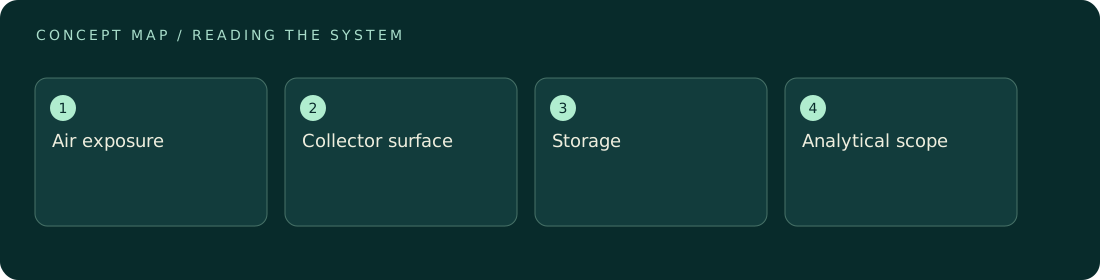
ILLUSTRATIVE · NOT A REPORTED RESULT
An example to work through
Assume a hypothetical report lists one analyte as below a 1-microgram-per-liter reporting limit. The justified statement is that this analyte was not quantified at or above that limit in the tested sample. It is not justified to call the water contaminant-free. If the collector yielded 5 liters, that volume does not change the analytical scope. This example deliberately supplies no drinking-water threshold: interpretation requires the actual analyte, method, jurisdiction, intended use, and qualified review of the complete analytical result and context.
Where interpretation fails
Clear appearance, low dissolved solids, or a pleasant taste cannot rule out all relevant hazards. Likewise, testing only collected water while ignoring storage can miss later changes. Avoid presenting a small set of measurements as a comprehensive safety certification for a harvesting system.
The next decision
For any proposed use, identify the responsible local authority and a suitably qualified laboratory. Ask what the selected tests can establish and what remains unmeasured. Keep the claim narrow until that review is complete; collection efficiency and potability are independent questions requiring different evidence.
Sources & context
These sources support the concepts noted below. Our synthetic examples and research framing are educational interpretation; they are not findings from these organizations or validation of our ventures.
- EPA: Certification programs and certified drinking-water laboratories ↗
Official qualified-laboratory guidance; no water safety certification inferred.
Source check: Search-result abstract or official excerpt reviewed; full paper methods not audited
Educational research context, not a validated device specification or clinical protocol. Read our editorial and correction policy.