
The essential answer
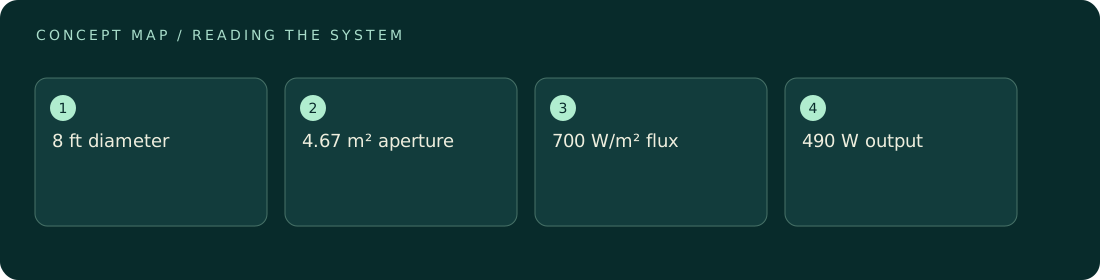
An illustrative circular tank with an eight-foot diameter has a horizontal area of 4.67 square metres. Under an assumed 700 watts per square metre of incident irradiance, that footprint intercepts about 3.27 kilowatts before losses. At an assumed 15 percent conversion efficiency, output is about 490 watts. Diameter, irradiance, and efficiency each enter separately; the presence of water or a large volume does not itself multiply the energy entering through the footprint.
How to reason about it
Specify what the eight-foot dimension means before calculating area. This case assumes internal horizontal diameter, not circumference, depth, or square side length. For a circular aperture, A=π(D/2)². Irradiance multiplied by projected collecting area gives incident power when the irradiance is defined on the same orientation. An efficiency then maps incident power to a stated useful output. Tank depth affects volume and thermal storage but does not increase the top aperture area. Reflectors could increase total collection only by adding separately accounted collecting area and optical constraints. The calculation uses a single steady irradiance for a hypothetical interval; it does not estimate annual yield. Shading, orientation, changing weather, and conversion losses are represented only through the explicitly assumed inputs.
ILLUSTRATIVE · NOT A REPORTED RESULT
An example to work through
Take illustrative diameter D=8 ft. Using 1 ft=0.3048 m gives D=2.4384 m and radius r=1.2192 m. The circular area is π×1.2192²=4.66982 m². At assumed irradiance I=700 W/m², incident power is IA=3268.87 W. If useful conversion efficiency is η=0.15, output is ηIA=490.331 W. Holding those assumptions constant for four hours gives 490.331×4=1961.32 Wh, or 1.96132 kWh. A target of 1000 W at the same flux and efficiency would require area 1000/(700×0.15)=9.52381 m², more than twice the tank aperture. Its equivalent circular diameter is sqrt(4A/π)=3.48225 m, about 11.4247 ft. These calculations address only a geometric energy ceiling under assumed conditions. They do not establish that a particular tank contains a converter or can achieve the selected efficiency. Water volume cannot be substituted for collector area in this multiplication.
Where interpretation fails
Confusing an eight-foot diameter with an eight-foot radius increases area by a factor of four. Quoting irradiance in watts per square metre and multiplying by square feet creates another unit error. The assumed efficiency is a scenario input, not a measured property of water, a tank, or an unspecified device.
The next decision
Write the aperture area and assumed irradiance beside any output claim. For this example, a kilowatt target cannot be reached with the stated footprint and efficiency under the stated flux. A revised concept must change a documented input or collect from a larger area, rather than rely on tank volume.
Sources & context
These sources support the concepts noted below. Our synthetic examples and research framing are educational interpretation; they are not findings from these organizations or validation of our ventures.
- NASA: First Law of Thermodynamics ↗
Energy accounting distinguishes transfers and stored energy.
Source check: Full short educational page read
Educational research context, not a validated device specification or clinical protocol. Read our editorial and correction policy.