
The essential answer
Spectral response describes how a measured electrical response changes with illumination wavelength under specified conditions. It helps distinguish devices that receive the same total optical power but interact differently with its spectrum. Current per incident optical power and electrons collected per incident photon are related but different quantities. A useful measurement records wavelength bandwidth, optical calibration, bias conditions, and sample temperature. A response under one lamp is not automatically transferable to sunlight or another light source with a different spectral distribution.
How to reason about it
The energy of a photon is inversely proportional to wavelength, so equal optical power at two wavelengths does not mean equal photon arrival rates. Decide whether the question concerns electrical response per watt, per photon, or per illuminated area. A monochromatic scan can isolate wavelength dependence, but filters, stray light, detector calibration, and source drift can affect the result. Some devices depend on a background illumination level or electrical bias, so a weak probing beam may not represent normal operation unless those conditions are reproduced. To predict performance under a broad source, combine a suitable response function with that source's measured spectrum and the device model, then validate against a direct measurement. This integration is conditional on response linearity and compatible operating state; it is not permission to add unrelated peak responses from different conditions into one optimistic prediction.
ILLUSTRATIVE · NOT A REPORTED RESULT
An example to work through
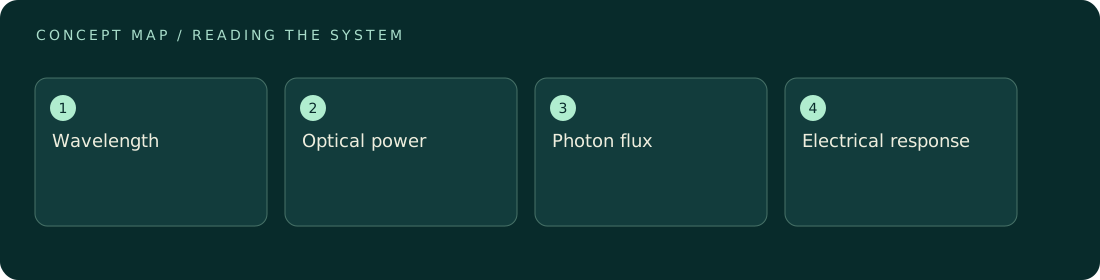
Assume two narrow beams each deliver 1 mW to the same hypothetical detector, one at 500 nm and one at 1,000 nm. Since photon energy halves when wavelength doubles, the 1,000 nm beam contains twice as many photons per second. If, purely for illustration, both wavelengths produce one collected electron per ten incident photons with identical collection conditions, the longer-wavelength beam produces twice the current. This says nothing about a real material's absorption threshold or conversion yield. Those could differ strongly and must be measured rather than assumed from photon counting alone.
Where interpretation fails
Equal lamp brightness to the eye is not equal optical power at the sample, and equal power is not equal photon flux. A narrow spectral peak also does not imply high overall conversion efficiency under a broad source. Keep the illumination and normalization definitions explicit.
The next decision
Use wavelength-resolved data when illumination sources differ or a mechanism depends on absorption bands. Report calibration and bias conditions with the curve. For an application claim, test under the relevant spectrum and loading rather than extrapolating from a favorable wavelength measured in isolation.
Sources & context
These sources support the concepts noted below. Our synthetic examples and research framing are educational interpretation; they are not findings from these organizations or validation of our ventures.
- Module spectral response measurements — NREL ↗
Official example of wavelength-resolved PV characterization.
Source check: Official institutional search excerpt reviewed.
Educational research context, not a validated device specification or clinical protocol. Read our editorial and correction policy.