
The essential answer
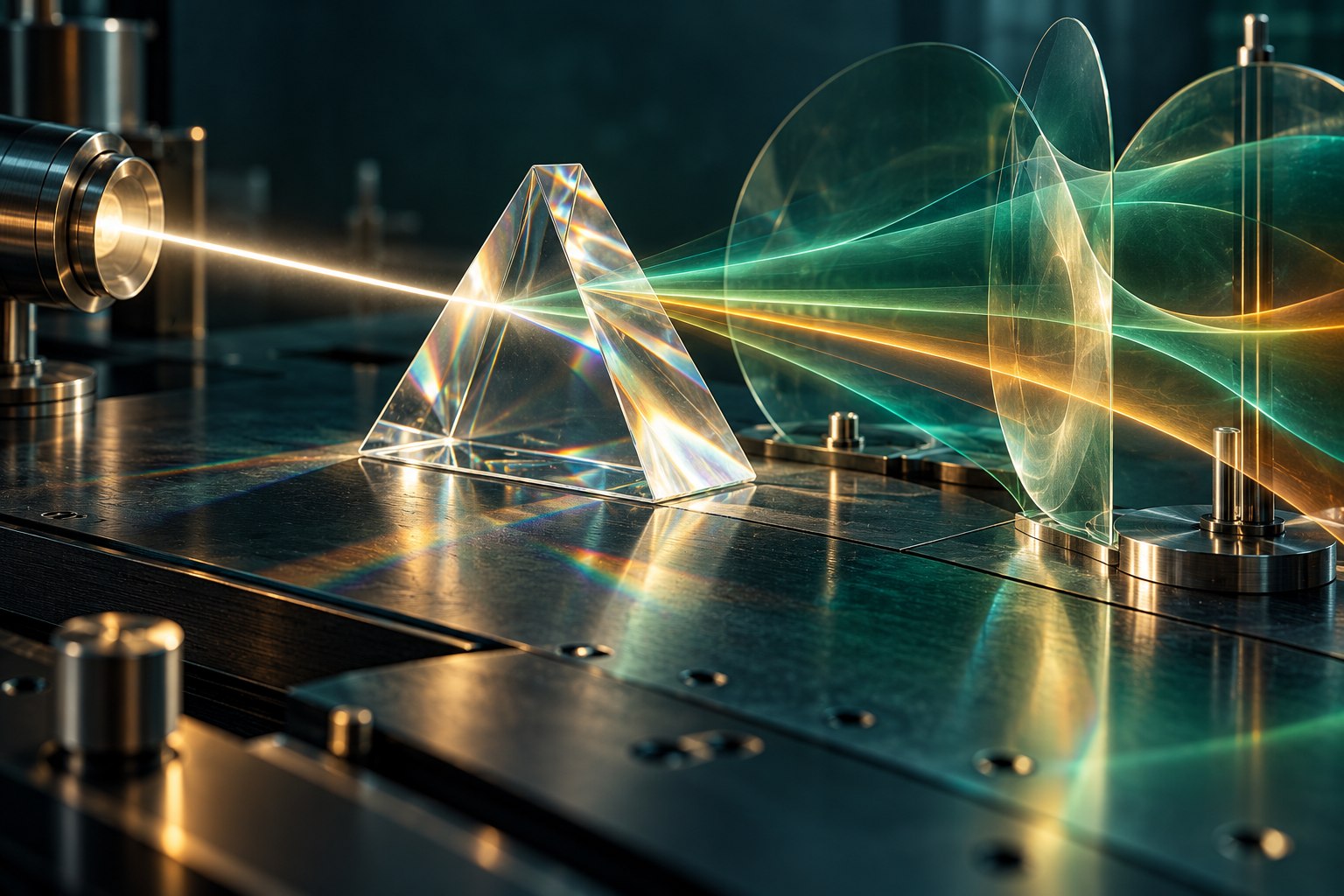
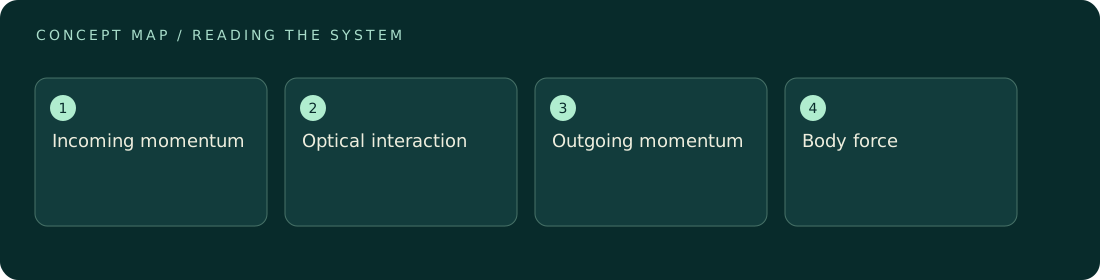
Light carries momentum. In vacuum, a photon of energy E has momentum magnitude E/c, so a beam of power P carries momentum at a rate P/c along its propagation direction. A fully absorbing surface at normal incidence receives force P/c; an ideal reflecting surface receives 2P/c because the outgoing momentum reverses. Real systems require a vector balance over all incoming and outgoing light. Internal reflections can load individual components without creating the same net external force on the complete assembly.
How to reason about it
Choose a surface enclosing the body whose force is being calculated. Sum incident momentum flux and subtract outgoing momentum flux, then account for any change of field momentum inside that boundary. In steady state the stored-field term has zero time average, leaving the flux balance. Absorption, specular reflection, diffuse scattering, and transmitted beams contribute differently because their outgoing directions differ. The simple vacuum expressions should not be carried unchanged into material media without specifying the mechanical and electromagnetic boundary. A power measurement alone cannot determine a vector force unless the angular distribution is known. For a finite beam, use the power actually intercepted by the body. Radiation pressure is often small enough that thermal and electrostatic effects require independent bounds, but its smallness does not make its momentum balance optional or mysterious. The numerical scale follows directly from c.
ILLUSTRATIVE · NOT A REPORTED RESULT
An example to work through
Assume an illustrative 3 W beam in vacuum strikes an ideal mirror normally and is fully intercepted. With c ≈ 3.00×10⁸ m/s, force is 2×3/c = 2.0×10⁻⁸ N, or 20 nN. A perfect absorber under the same conditions receives 10 nN. If the mirror and the source are mounted inside one closed enclosure and all light is ultimately absorbed internally, the forces on individual parts must be combined; the mirror's 20 nN load alone is not a net external thrust for the whole enclosure.
Where interpretation fails
Counting every internal bounce as additional net thrust double counts momentum exchanges within the chosen system. Multiple reflections can amplify the load on a particular sensor or mirror, but the enclosing assembly's external force is still determined by momentum crossing its boundary and changes in stored momentum.
The next decision
Use P/c or 2P/c only after checking the boundary, incidence direction, interception, and optical fate. For complex optics, enumerate every exiting beam and its power vector. Compare the predicted force with an independently calibrated sensor and an uncertainty budget that includes angular distribution and parasitic-force bounds.
Sources & context
These sources support the concepts noted below. Our synthetic examples and research framing are educational interpretation; they are not findings from these organizations or validation of our ventures.
- NIST: Use of radiation pressure for measurement of high-power laser emission ↗
Radiation pressure as optical power measurement; abstract checked, no performance values reused.
Source check: Relevant excerpt or resource metadata checked; see support note. Original illustrative calculation, not source data.
Educational research context, not a validated device specification or clinical protocol. Read our editorial and correction policy.