

The essential answer
Polarization describes the time-dependent orientation of a light wave's electric field. Linear, circular, and elliptical states can interact differently with anisotropic materials, coatings, gratings, and interfaces. Changing polarization may therefore change reflected power, absorbed power, scattering direction, or angular momentum transfer. A polarization-dependent force is not automatically evidence of a new mechanism. Track the optical power and output channels for each state, and specify the basis, handedness convention, wavelength, and incidence geometry used to define the polarization.
How to reason about it
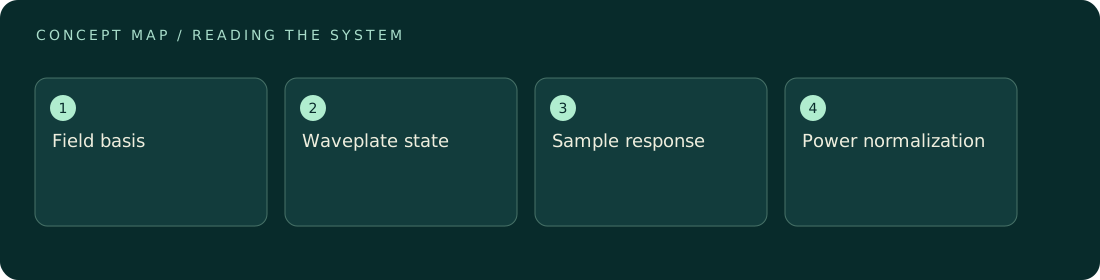
A Jones vector is convenient for fully polarized coherent light in a chosen transverse basis; Stokes parameters also describe partial polarization. Rotating a polarizer changes transmitted power according to the field projection for an ideal linear input. Waveplates change relative phase between components, but their retardance depends on wavelength and angle. At oblique incidence, s and p components have different Fresnel coefficients, so an upstream polarization rotation can change both radiation pressure and heating. Stress birefringence and fiber motion can alter the state before it reaches the sample even if the source setting is fixed. Measure polarization close to the interaction plane and account for intervening optics. For circular states, specify viewing direction and convention to avoid sign errors in torque interpretation. A full state measurement can reveal ellipticity that a single analyzer setting would miss.
ILLUSTRATIVE · NOT A REPORTED RESULT
An example to work through
Assume a hypothetical 10 mW linearly polarized beam meets an ideal polarizer at 30 degrees to its transmission axis. Transmitted power is 10 cos²30° = 7.5 mW. At 60 degrees it is 2.5 mW. If a downstream ideal mirror receives these powers, its normal radiation-pressure force changes by a factor of three even though the mirror has no intrinsic polarization dependence. A comparison intended to isolate sample polarization response must therefore normalize or stabilize the power after the polarization optics, not only at the laser output.
Where interpretation fails
Do not assume rotating a half-wave plate changes only polarization. Beam walk, coating losses, and imperfect retardance may change power or pointing. A force difference can follow these changes. A polarizer extinction measurement alone also does not establish circular polarization or the absence of depolarized light.
The next decision
For a polarization comparison, hold incident power and geometry fixed within their uncertainty and measure the state at the sample. Record reflected, transmitted, and absorbed fractions where relevant. Interpret a residual difference only after ordinary polarization-dependent optical and thermal responses have been included in the model.
Sources & context
These sources support the concepts noted below. Our synthetic examples and research framing are educational interpretation; they are not findings from these organizations or validation of our ventures.
- MIT Optics: Polarization and Waveplates ↗
Further reading on polarization; official resource page checked.
Source check: Relevant excerpt or resource metadata checked; see support note. Original illustrative calculation, not source data.
Educational research context, not a validated device specification or clinical protocol. Read our editorial and correction policy.