
The essential answer
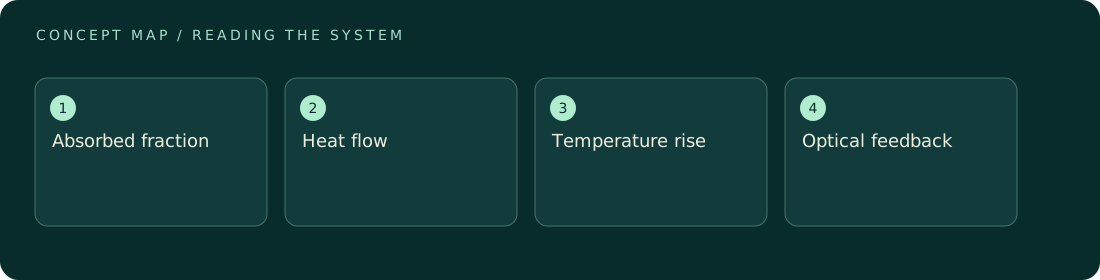
Optical loss from a selected mode is not always heat. Power can scatter into other optical modes, transmit through a coupler, or be absorbed and converted to thermal energy. Heating estimates require the absorptive part. Once absorbed power is known, temperature depends on thermal conductance, heat capacity, geometry, and environment. Resonators can amplify local intensity and make small absorption important. A power-dependent resonance shift or force signal may therefore reflect thermal feedback even when total incident power appears modest.
How to reason about it
A lumped model writes C dΔT/dt = Pabs−GΔT, with steady temperature rise Pabs/G and time constant C/G. This approximation assumes one relevant temperature and linear conductance; real multilayer optics may have gradients and several thermal modes. Temperature can change refractive index, dimensions, coating stress, and cavity detuning. Detuning changes stored energy, which changes absorption again, producing feedback and potentially asymmetric scans or bistability. Distinguish intrinsic absorption from total cavity linewidth loss, since scattering and output coupling do not necessarily heat the measured component. Use spatially resolved or well-placed thermometry when gradients matter. A thermal model fitted only to one optical observable may be underconstrained, so compare independent power, temperature, and mechanical measurements. Vacuum changes gas cooling but leaves solid conduction and thermal radiation, making environmental dependence an important part of model validation.
ILLUSTRATIVE · NOT A REPORTED RESULT
An example to work through
Assume an illustrative optic absorbs 0.5% of a 2 W beam, giving Pabs = 10 mW. Let thermal conductance be 20 mW/K and heat capacity 0.10 J/K. The steady temperature rise is 0.010/0.020 = 0.50 K and time constant is 0.10/0.020 = 5 s. After one time constant following a step, the rise is 0.50(1−e⁻¹) = 0.316 K. These values assume constant absorption and conductance. If resonance detuning changes absorption during heating, the simple exponential no longer describes the complete response.
Where interpretation fails
Do not convert every missing milliwatt in a single collected beam into local heating. Scattered power may be absorbed elsewhere, creating a different thermal pathway. Conversely, a very small absorptance can still dominate a delicate mechanical measurement if thermal conductance is weak or expansion couples strongly to the readout.
The next decision
Measure or bound absorptance separately from total mode loss, then test the thermal model with power steps and independent temperature data. If heating changes the optical state, solve the coupled response or operate where that feedback is negligible. Include the uncertainty of thermal coupling in any corrected force result.
Sources & context
These sources support the concepts noted below. Our synthetic examples and research framing are educational interpretation; they are not findings from these organizations or validation of our ventures.
- The NIST Length Scale Interferometer ↗
Temperature and environmental corrections; relevant article passages checked.
Source check: Relevant excerpt or resource metadata checked; see support note. Original illustrative calculation, not source data.
Educational research context, not a validated device specification or clinical protocol. Read our editorial and correction policy.