
The essential answer
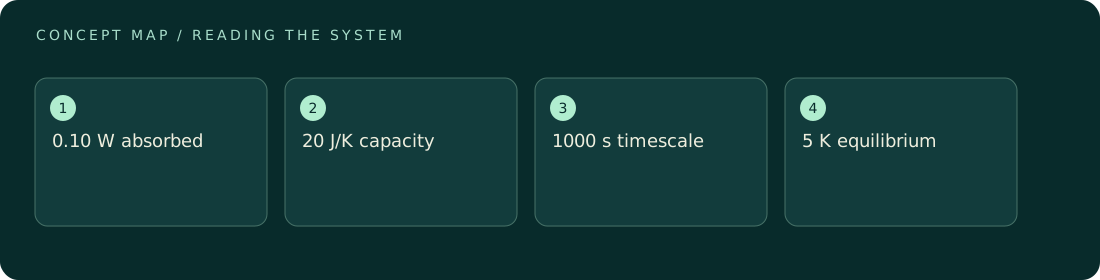
An illustrative 5 watt beam with 2 percent absorption deposits 0.10 watt of heat. A body with heat capacity 20 joules per kelvin would initially warm at 0.005 kelvin per second. With thermal conductance 0.020 watt per kelvin to its surroundings, its steady temperature rise is 5 kelvin. These thermal numbers coexist with only 0.334 nanonewtons of direct momentum force from the absorbed fraction, so weak absorption can matter greatly in precision measurements.
How to reason about it
A lumped thermal model writes C dΔT/dt=Pabs−GΔT. It assumes an approximately uniform body temperature, constant heat capacity C, constant conductance G, and an environment at fixed temperature. The solution after switching on constant absorbed power is ΔT(t)=(Pabs/G)(1−exp(−tG/C)). The thermal time constant is C/G. This model is deliberately simpler than spatial heat transport, nonlinear radiative cooling, or temperature-dependent absorption. Its purpose is to show why a small fraction of optical power may generate a slow changing background. The direct momentum contribution from absorbed light is Pabs/c along the incident beam. Other transmitted or reflected light has its own momentum balance. No force caused by thermal expansion is calculated unless mechanical geometry and coupling are specified.
ILLUSTRATIVE · NOT A REPORTED RESULT
An example to work through
Assume illustrative incident power 5 W and absorption fraction a=0.020. Then Pabs=aP=0.100 W. With C=20 J/K, the initial slope is Pabs/C=0.005 K/s, or 0.30 K/min. Let G=0.020 W/K. The equilibrium temperature rise is Pabs/G=5 K and the time constant is τ=C/G=1000 s. At t=600 s, ΔT=5(1−exp(−0.6))=2.25594 K. A no-loss estimate would instead give 0.100×600/20=3 K; cooling explains the difference. At 1000 s the rise is 3.16060 K, approximately 63.2 percent of equilibrium. The force associated specifically with absorbed optical momentum is 0.100/299792458=3.33564×10⁻¹⁰ N, or 0.333564 nN. This is not the total optical force unless the other light leaves without changing momentum. A delayed sensor response matching the thermal time constant would motivate a thermal hypothesis, but would not prove it alone.
Where interpretation fails
Using incident power as deposited heat overestimates heating when most light exits. Using only the absorbed fraction to compute total force can underestimate recoil when reflection or redirection matters. Thermal equilibrium also does not mean zero heat flow: at equilibrium the outgoing heat flow equals the continuing absorbed power.
The next decision
Keep separate energy and momentum budgets, and compare their predicted time dependence with the observation. The useful outcome here is a thermal timescale and plausible temperature rise, not an inferred parasitic force. A displacement or force prediction requires a further model linking temperature to expansion, stress, or sensor response.
Sources & context
These sources support the concepts noted below. Our synthetic examples and research framing are educational interpretation; they are not findings from these organizations or validation of our ventures.
- NASA: First Law of Thermodynamics ↗
Energy accounting distinguishes transfers and stored energy.
Source check: Full short educational page read
Educational research context, not a validated device specification or clinical protocol. Read our editorial and correction policy.