
The essential answer
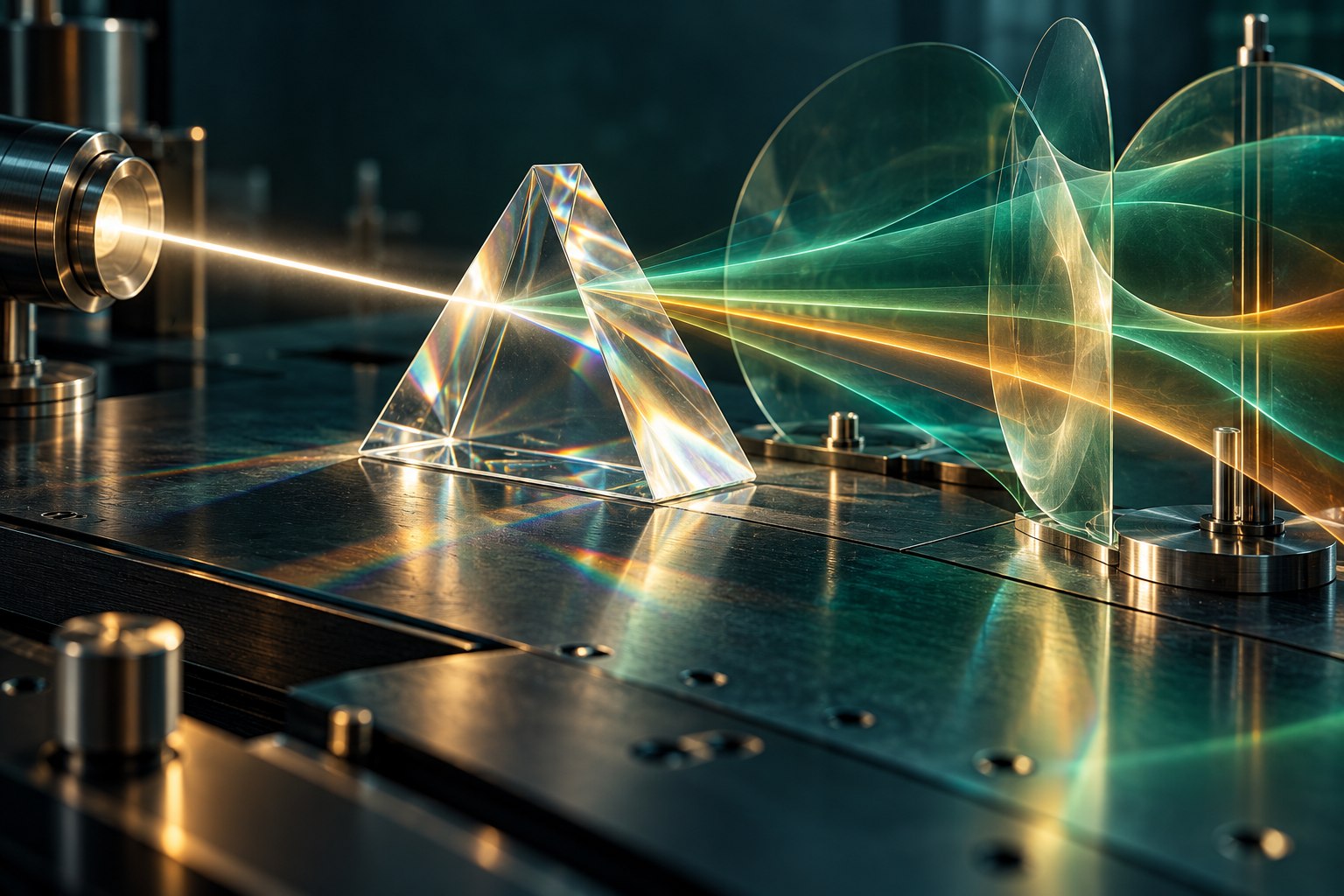
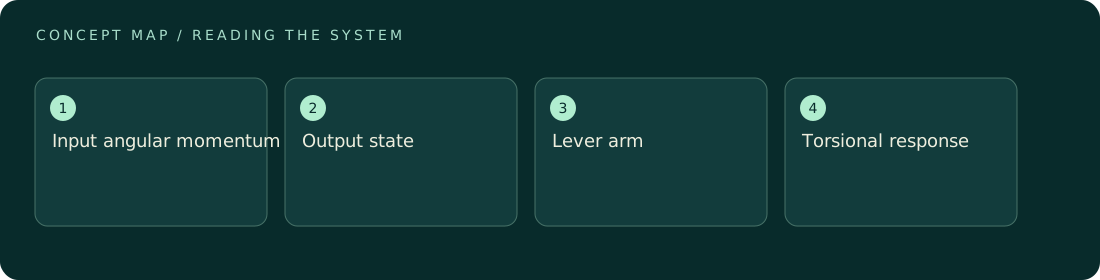
Light can transfer angular momentum as well as linear momentum. Circular polarization carries spin angular momentum, and structured fields can carry orbital angular momentum. A body's optical torque depends on the difference between incoming and outgoing angular momentum flux about a specified origin. A force applied away from the rotation axis also creates torque through a lever arm. These contributions require careful geometry and polarization bookkeeping. Rotation alone does not identify the angular-momentum mechanism, because heating and asymmetric scattering can also generate mechanical torque.
How to reason about it
For an ideal fully absorbed circularly polarized monochromatic beam, spin torque magnitude is P/ω, where ω is optical angular frequency. A polarization transformation can transfer spin without complete absorption, depending on the outgoing state. Orbital angular momentum requires the field's spatial structure and the chosen axis to be specified; a displaced ordinary beam can also have angular momentum about a remote origin. In a torsional sensor, convert angular motion through the calibrated torsional response, including resonance and damping. Reversing helicity is a useful test for spin torque, but waveplates can change power, pointing, or heating and thereby introduce other odd responses. Measure the outgoing polarization whenever possible so angular momentum transfer is inferred from the actual optical change. Keep torque units distinct from force units even though both involve momentum transfer, and include all external optical channels for a complete assembly.
ILLUSTRATIVE · NOT A REPORTED RESULT
An example to work through
Assume a hypothetical fully absorbing target receives 10 mW of circularly polarized light at wavelength 1 µm in vacuum. Angular frequency is ω = 2πc/λ ≈ 1.885×10¹⁵ rad/s. The ideal spin torque is P/ω ≈ 5.31×10⁻¹⁸ N·m. By comparison, a 1 nN ordinary force acting 1 mm from an axis gives 10⁻¹² N·m, far larger. These illustrative values show why beam centering and lever-arm forces can dominate a torsion experiment intended to detect polarization angular momentum transfer. The comparison assumes both torques act about the same sensitive axis.
Where interpretation fails
Do not assume every observed rotation is spin torque or that a helicity switch changes only spin. A tiny beam displacement can create a much larger lever-arm torque. Also avoid applying P/ω to an arbitrary reflected or transmitted state without accounting for its outgoing angular momentum.
The next decision
Use helicity and spatial-mode controls together with power and pointing monitors. Calibrate the torsional transfer function and bound lever-arm forces at the actual beam position. A convincing angular-momentum interpretation should predict both sign and magnitude from measured input and output optical states, within an explicit uncertainty budget.
Sources & context
These sources support the concepts noted below. Our synthetic examples and research framing are educational interpretation; they are not findings from these organizations or validation of our ventures.
- He, Li and Li: Optomechanical measurement of photon spin angular momentum ↗
Polarization-dependent optical torque; research abstract checked.
Source check: Relevant excerpt or resource metadata checked; see support note. Original illustrative calculation, not source data.
Educational research context, not a validated device specification or clinical protocol. Read our editorial and correction policy.