
The essential answer
For an ideal specular mirror in vacuum, a beam with intercepted power P incident at angle θ from the surface normal produces normal force 2P cosθ/c. Tangential momentum is unchanged by ideal specular reflection, so the net force is normal to the surface. If instead the input is intensity per area perpendicular to the beam, the intercepted power itself contains a projected-area factor. That produces the familiar cos²θ dependence of pressure on the physical mirror area. State which power or intensity is held fixed.
How to reason about it
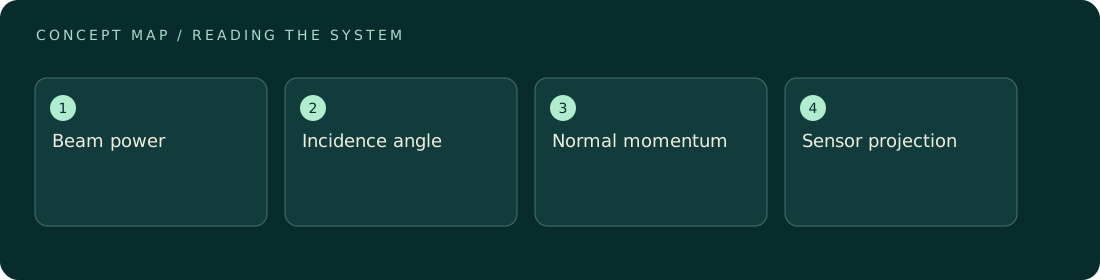
Resolve incident and reflected momentum vectors into normal and tangential components. The normal component changes sign while the tangential component is preserved. This vector construction avoids mixing surface-normal force with force projected onto a laboratory axis. An absorbing surface behaves differently: it receives the incident momentum vector rather than a doubled normal component. Partial reflection and absorption require their separate contributions. At oblique incidence, reflectance often depends on polarization and angle, so treating R as constant can introduce a systematic error. The beam footprint also grows, making clipping and coating nonuniformity more likely. In a practical setup, measure the intercepted power and angle at the optic, then project the predicted force onto the sensor's sensitive direction. The relevant angle uncertainty can become important near grazing incidence, where small angular changes strongly affect the projected component.
ILLUSTRATIVE · NOT A REPORTED RESULT
An example to work through
Assume an illustrative ideal mirror intercepts 6 W at 60 degrees from its normal. The normal force is 2×6×cos60°/(3×10⁸) = 20 nN. At normal incidence with the same intercepted power it would be 40 nN. Now assume instead a fixed beam intensity of 600 W/m² and a mirror area of 0.01 m² fully illuminated. At 60 degrees, intercepted power is 600×0.01×0.5 = 3 W, so force is 10 nN. The extra factor of two comes from projected area, not a different momentum law.
Where interpretation fails
Do not combine a power already measured at the tilted mirror with another projected-area factor unless converting to pressure. That counts the geometric reduction twice. Also avoid assuming the sensor measures normal force: a tilted sensitive axis introduces a separate projection that must be included in the model.
The next decision
Write the input as either total intercepted power or incident intensity before calculating. Verify beam clipping, angle, polarization, and sensor-axis projection. If changing angle is used as a mechanism test, stabilize or measure all these quantities so an apparent cosine trend cannot be produced by changing collected power alone.
Sources & context
These sources support the concepts noted below. Our synthetic examples and research framing are educational interpretation; they are not findings from these organizations or validation of our ventures.
- NIST: Use of radiation pressure for measurement of high-power laser emission ↗
Radiation pressure as optical power measurement; abstract checked, no performance values reused.
Source check: Relevant excerpt or resource metadata checked; see support note. Original illustrative calculation, not source data.
Educational research context, not a validated device specification or clinical protocol. Read our editorial and correction policy.