
The essential answer
Power per area is meaningful only when the area is specified. Projected area is the footprint viewed along a defined direction. Illuminated area is the region receiving the stated light field. Geometric electrode area and internal surface area describe other boundaries. A porous electrode can increase internal interface area without increasing the light-catching footprint. Report total power alongside the normalized result so readers can understand scale. Use the same denominator when comparing devices, and explain any masking, inactive margins, or partial illumination.
How to reason about it
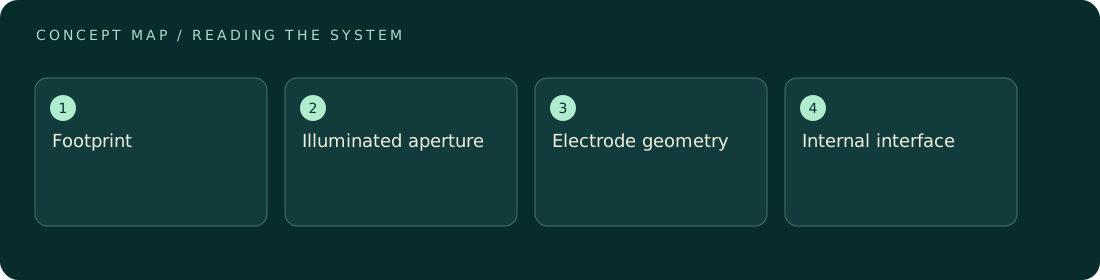
Area normalization should follow the question being asked. For deployment on a limited surface, footprint may be the useful denominator. For comparing local electrode processes, geometric exposed electrode area may be more informative. For light conversion, the incident optical energy must be measured over the appropriate illuminated aperture and orientation. Surface texture can enlarge microscopic area, but it does not automatically increase intercepted light by the same factor. Distinguish these concepts before calculating efficiency or claiming a scaling advantage. A sketch of the device can show the aperture, footprint, electrodes, and light direction without pretending that all areas coincide. Also record whether the device is viewed face-on or at an angle. Even a correct division becomes misleading if the numerator includes output from regions excluded from the denominator or from several stacked components counted as one small patch.
ILLUSTRATIVE · NOT A REPORTED RESULT
An example to work through
Assume an invented device produces 2 mW. Its rectangular footprint is 4 cm by 5 cm, or 20 cm², while the illuminated aperture is 10 cm². The footprint-normalized result is 0.10 mW/cm² and the aperture-normalized result is 0.20 mW/cm². Both calculations are correct but answer different questions. Suppose the porous electrode has a separately estimated internal area of 1,000 cm². Dividing by that area gives 0.002 mW/cm² and cannot be compared directly with either earlier value. The calculation assumes that all output belongs to this single device.
Where interpretation fails
Selecting whichever denominator makes a result look largest prevents meaningful comparison. A microscope image does not necessarily measure electrochemically accessible area, and an internal-area estimate does not establish optical capture. Keep measurement method and area definition attached to every reported normalized number.
The next decision
Report absolute power, the chosen area value, and its physical definition together. Add a second normalization if it serves a different clearly stated question. When comparing published devices, recalculate on a common basis only if the necessary dimensions and illumination conditions are actually available.
Sources & context
These sources support the concepts noted below. Our synthetic examples and research framing are educational interpretation; they are not findings from these organizations or validation of our ventures.
- Solar cell characterization — NIST ↗
Background on photovoltaic characterization and spectral measurement modes; no performance results reproduced.
Source check: Official PDF search excerpt reviewed.
Educational research context, not a validated device specification or clinical protocol. Read our editorial and correction policy.