
The essential answer
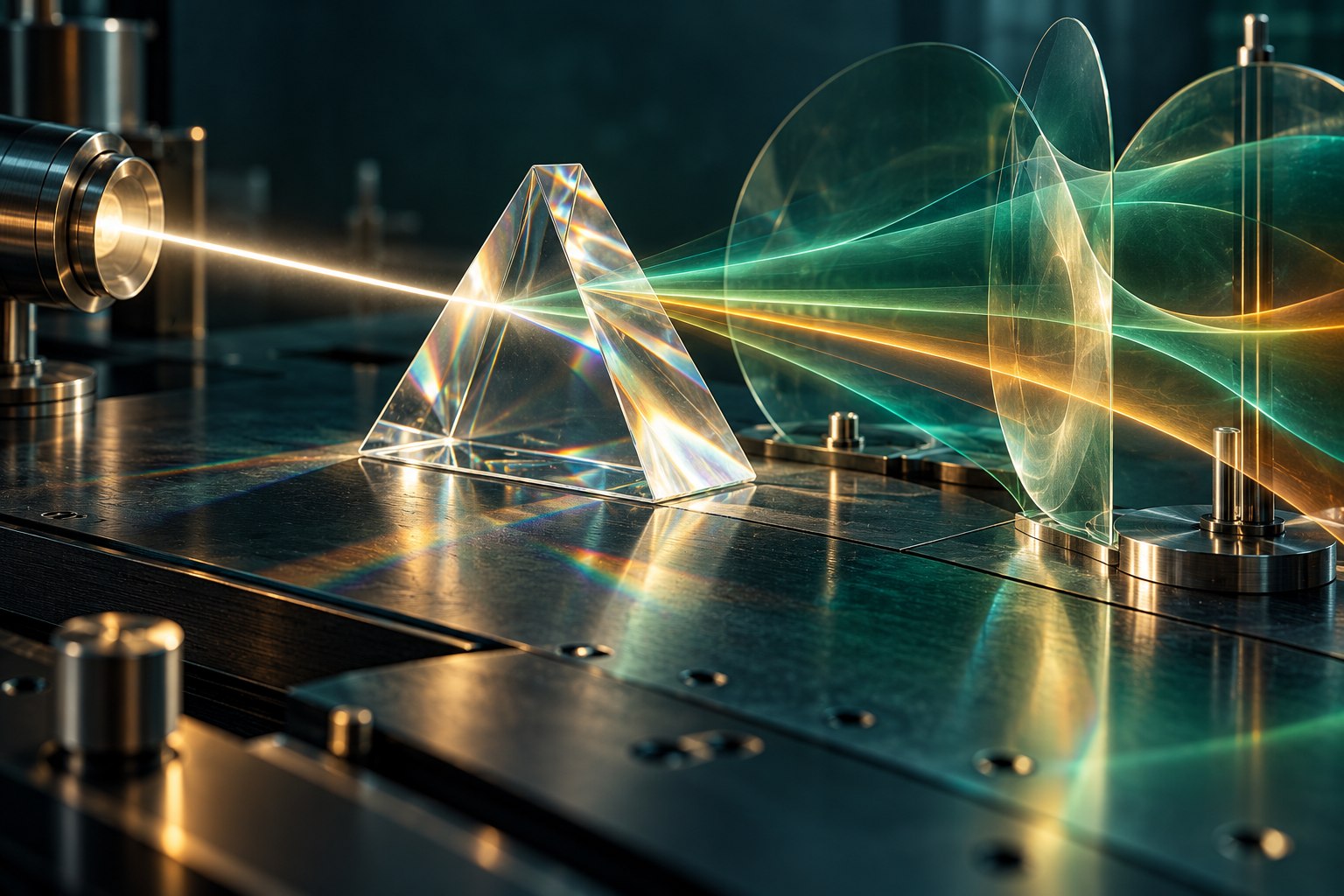
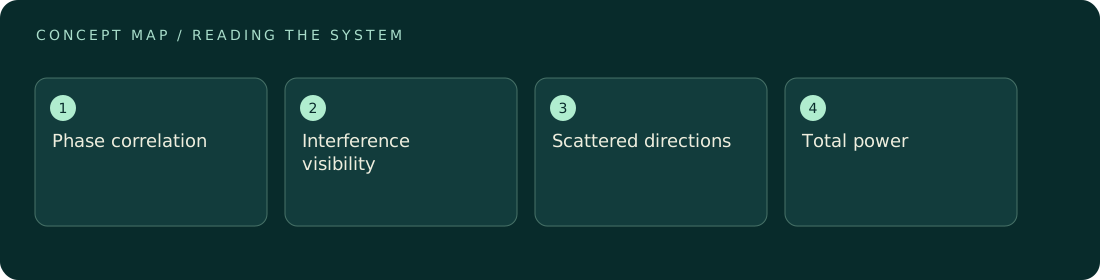
Coherence describes correlations between optical fields at different times or positions. Scattering describes redistribution by an interaction with matter. They are not opposites: coherent light can scatter coherently and form speckle, while incoherent light can still deliver momentum. Reduced interference visibility does not necessarily mean increased absorption or reduced total power. When interpreting a force experiment, distinguish phase information, angular redistribution, and energy loss. Each affects a different part of the optical model and requires a different measurement.
How to reason about it
Temporal coherence sets how much path delay can be tolerated before interference averages away; spatial coherence governs correlations across a wavefront. A rough stationary surface illuminated by coherent light can produce a stable speckle pattern because scattered contributions interfere. Motion or spectral bandwidth can average that pattern without removing its total optical energy. Conversely, a highly coherent beam can be partially absorbed. For a two-beam interferometer, visibility depends not only on coherence but also on unequal intensities, polarization mismatch, and imperfect overlap. A reduction in contrast therefore has several possible causes. Force depends on momentum exchange summed over optical outputs, even when relative phases fluctuate too rapidly to produce a stable visible pattern. Coherence can affect the distribution through interference or cavity coupling, but it does not permit energy or momentum bookkeeping to be skipped. Measure total and angular power separately from fringe contrast.
ILLUSTRATIVE · NOT A REPORTED RESULT
An example to work through
Assume two hypothetical perfectly coherent, identically polarized beams with intensities I1 = 9 and I2 = 1 in arbitrary units. Ideal fringe visibility is 2sqrt(I1I2)/(I1+I2) = 6/10 = 0.6. Thus 60% visibility does not imply a degree of coherence of 0.6; unequal powers alone explain it. If both intensities were equal and all other conditions matched, visibility could then probe coherence. For a scattering sample, the same distinction prevents interpreting a weak interference signal as proof that most incident energy was absorbed.
Where interpretation fails
Do not equate “incoherent” with “random directions” or zero momentum. A narrow unpolarized or temporally incoherent beam still has a definite average propagation direction. Likewise, disappearance of speckle under averaging says little about total scattering loss unless a power measurement accompanies the image.
The next decision
Choose coherence measurements to answer phase-correlation questions and power or angular measurements to answer energy and force questions. Before attributing reduced fringe visibility to decoherence, check intensity balance, polarization, alignment, and detector averaging. Use separate controls for absorption and scattering rather than combining them into one unspecified optical loss.
Sources & context
These sources support the concepts noted below. Our synthetic examples and research framing are educational interpretation; they are not findings from these organizations or validation of our ventures.
- MIT Optics: Superposition and Interference ↗
Further reading on wave superposition; official resource page checked.
Source check: Relevant excerpt or resource metadata checked; see support note. Original illustrative calculation, not source data.
Educational research context, not a validated device specification or clinical protocol. Read our editorial and correction policy.