

The essential answer
An evanescent field has an exponentially decaying amplitude in one direction rather than propagating freely in that direction. It occurs in total internal reflection, guided modes, and subwavelength structures. The field is real and can interact strongly with nearby matter, producing forces or coupling energy into another structure. Exponential decay does not mean the field carries no energy or momentum in every direction. To calculate a force, use the complete electromagnetic and material boundary conditions rather than treating the decay length as a force law.
How to reason about it
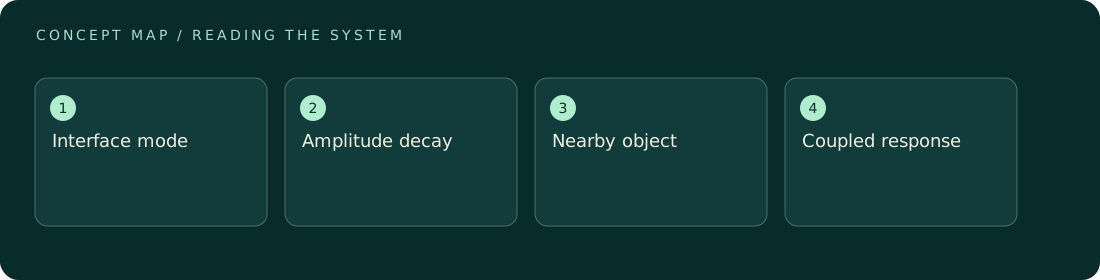
At a planar interface under total internal reflection, the wavevector component parallel to the interface is preserved, while the perpendicular component in the lower-index medium becomes imaginary. The field amplitude decays as exp(−κz), and intensity as exp(−2κz). These have different characteristic lengths. A nearby prism, particle, or waveguide can frustrate total internal reflection and enable energy transfer, changing the original field. Near-field forces can include gradient contributions that depend on polarizability and spatial variation; absorption and scattering add other contributions. A probe is therefore not necessarily passive. In a guided mode, the evanescent tail is part of a larger energy-carrying solution whose normalization matters. Distinguish local forces between nearby components from the net force on an enclosing assembly. A full stress-tensor or equivalent momentum calculation must include all interacting bodies and outgoing channels.
ILLUSTRATIVE · NOT A REPORTED RESULT
An example to work through
Assume an illustrative evanescent intensity follows I(z) = I0 exp(−2κz) with κ = 5 µm⁻¹. Its intensity 1/e distance is 1/(2κ) = 0.10 µm, or 100 nm; the amplitude 1/e distance is 200 nm. Moving a probe from 100 nm to 200 nm reduces the unperturbed intensity by exp(−1) ≈ 0.368. This does not automatically reduce force by the same factor, because probe response and field perturbation may change. The calculation only describes the assumed background field before self-consistent coupling is considered.
Where interpretation fails
Do not claim that exponential decay permits momentum transfer without reaction on the source structure. Near-field interactions redistribute forces among bodies and fields. Also avoid confusing amplitude and intensity decay lengths; the factor of two can produce substantial errors in inferred gaps or coupling strengths.
The next decision
Use an evanescent model when dimensions and separations justify a near-field treatment. State decay conventions, mode normalization, material response, and whether the probe perturbs the field. Validate gap dependence independently, and compute the complete interacting system when using a local near-field force to infer a whole-device load.
Sources & context
These sources support the concepts noted below. Our synthetic examples and research framing are educational interpretation; they are not findings from these organizations or validation of our ventures.
- MIT Optics: Total Internal Reflection and Evanescent Waves ↗
Relevant PDF text on total and frustrated internal reflection inspected.
Source check: Relevant excerpt checked; original illustrative calculation, not source data.
Educational research context, not a validated device specification or clinical protocol. Read our editorial and correction policy.