

The essential answer
A gradient is a difference across space, such as a difference in chemical potential or temperature. Such differences can matter because they provide opportunities for directed processes. But identifying a gradient does not show that a particular chemical system can use it effectively. Origins hypotheses must connect an environmental difference with a specified mechanism and outcome. The cited active-droplet model studies behavior maintained away from equilibrium; it illustrates conditional reasoning rather than establishing the actual historical route by which life began.
How to reason about it
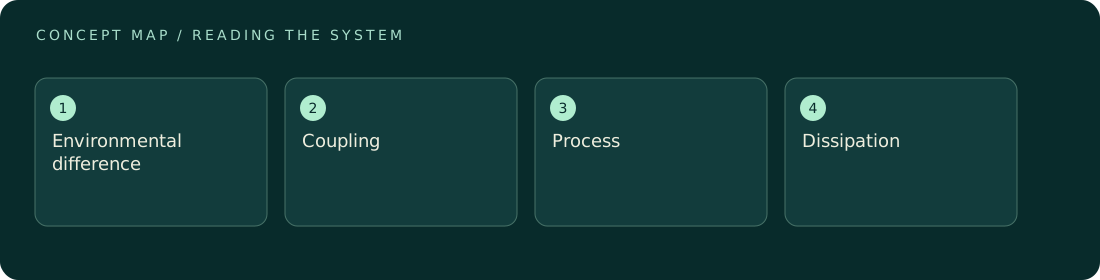
The phrase energy is available compresses several questions. Available where? Across which boundary? For which process? Over what time? A landscape may contain a difference without the proposed system possessing a way to couple that difference to the behavior of interest. Drawing an arrow from environment to system is therefore a claim that needs explanation, not a substitute for one. A good conceptual model makes the input, output, and assumptions explicit. It also distinguishes a maintained gradient from a difference that simply dissipates. Neither case should be judged by the visual prominence of the arrow. The relevance of an environmental setting depends on whether its conditions support the proposed mechanism, and whether alternative settings or mechanisms could produce the same observation.
ILLUSTRATIVE · NOT A REPORTED RESULT
An example to work through
Imagine two hypothetical water-level diagrams used only as analogies. One has two reservoirs at different heights but no connection between them. The other has a connection and a specified device that responds to flow. The height difference alone does not tell us what the device accomplishes. Now replace the reservoirs with abstract high and low states in a chemical model. The same interpretive gap remains: an available difference and a useful process are separate parts of the explanation. This analogy supplies no chemical design and does not claim that early life used a particular natural setting.
Where interpretation fails
Avoid treating any energetic environment as automatically favorable for the proposed process. The relevant question is coupling, not spectacle. Also distinguish showing that a mechanism is physically possible from showing that the necessary conditions existed in a particular place and period on the early Earth.
The next decision
For a gradient-based hypothesis, identify the difference, the proposed coupling, and the resulting observable. Ask what maintains the difference and what would happen if it disappeared. Keep environmental plausibility and demonstrated mechanism as separate evidence categories until the relationship between them has been supported.
Sources & context
These sources support the concepts noted below. Our synthetic examples and research framing are educational interpretation; they are not findings from these organizations or validation of our ventures.
- Growth and Division of Active Droplets: A Model for Protocells ↗
The original model concerns externally sustained, nonequilibrium droplet behavior.
Source check: Original research preprint abstract opened; model not independently validated.
Educational research context, not a validated device specification or clinical protocol. Read our editorial and correction policy.