

The essential answer
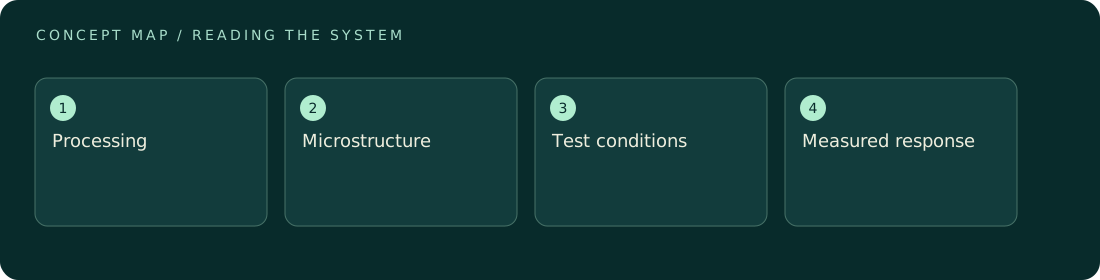
A material property is a measured response under specified conditions, not a complete description of a substance. Composition, microstructure, defects, interfaces, and processing can all influence that response. A structure-property relationship connects an identified structural feature with an observable such as stiffness, conductivity, or strength. Establishing causation requires controlling other changes that accompany the feature. A strong explanation states the relevant length scale, loading or field conditions, and uncertainty rather than claiming that one attractive micrograph explains every performance difference.
How to reason about it
Start by defining the property and the scale at which it is measured. A local indentation result may differ from the behavior of a porous bulk specimen; a single conductive grain does not establish macroscopic conductivity across poorly connected grains. Then identify which structural descriptor could plausibly affect the transport or deformation pathway. Examples include orientation, pore fraction, grain size, or interface continuity. Processing often changes several descriptors together, so a correlation across processing conditions may not isolate one cause. Use matched specimens, complementary measurements, or a model that predicts an independently testable change. Keep the model's assumptions visible: ideal alignment, perfect bonding, uniform fields, and absence of defects are often conveniences rather than observations. The most useful relationship supports a prediction within a defined range and indicates what additional measurement would challenge it.
ILLUSTRATIVE · NOT A REPORTED RESULT
An example to work through
Assume an illustrative composite contains equal volumes of two linear elastic phases with moduli 10 and 2 GPa. Under an ideal equal-strain arrangement, the parallel estimate is 0.5 × 10 + 0.5 × 2 = 6 GPa. Under an ideal equal-stress arrangement, the series estimate is 1/(0.5/10 + 0.5/2), about 3.33 GPa. These are simplified one-dimensional arrangements with perfect bonding, not measured bounds for every complex specimen. The different predictions show why phase fractions alone do not determine response: geometry and loading assumptions matter too.
Where interpretation fails
A visually distinctive structure can be a marker of processing rather than the cause of improved performance. Comparing one image from each sample also hides heterogeneity. Pair representative structural statistics with the property measurement and avoid inferring bulk behavior from a conveniently selected microscopic region.
The next decision
Choose a structural descriptor tied to a plausible mechanism, then test a prediction beyond the data used to propose it. Report composition, processing, specimen scale, and test conditions. If multiple features changed together, describe the relationship as an association until a more selective comparison is available.
Sources & context
These sources support the concepts noted below. Our synthetic examples and research framing are educational interpretation; they are not findings from these organizations or validation of our ventures.
- Structure-Property Relationships for High-Strength Materials — NIST ↗
Background connecting chemical and structural properties to mechanical behavior and environmental exposure.
Source check: Official program search excerpt reviewed.
Educational research context, not a validated device specification or clinical protocol. Read our editorial and correction policy.