
The essential answer
An optical cavity stores electromagnetic energy by repeatedly circulating light. Resonant buildup can increase the power incident on internal mirrors and therefore their local radiation-pressure loads. Stored energy is not an independent continuous energy source, and internal force enhancement is not automatically enhanced net thrust of the entire apparatus. At steady state, input power balances transmitted, reflected, absorbed, and other losses. During filling or decay, the change in stored energy must also be included in the energy balance.
How to reason about it
Define U as stored energy and κ as its total energy decay rate, so freely decaying energy follows U(t) = U0 exp(−κt). The total loss power is κU. Coupling determines how efficiently an external beam feeds the resonator, while internal loss determines what fraction becomes heat. Circulating power depends on geometry and the convention used for traveling or standing waves, so state the relation to U rather than applying an unexplained buildup factor. A mirror's force can be computed from the fields incident on its two sides; the complete cavity's force requires all external optical ports and support interactions. Detuning changes stored energy and can create optical spring effects when mirror motion feeds back onto the field. For a transient, neither a steady-state power relation nor a static force conversion necessarily applies. Measure ringdown or linewidth with the relevant coupling conditions specified.
ILLUSTRATIVE · NOT A REPORTED RESULT
An example to work through
Assume an illustrative cavity stores U = 2 µJ and has energy lifetime τ = 10 µs. Its total loss power during an instant of free decay is U/τ = 0.20 W. After one lifetime the energy is 2/e = 0.736 µJ. If 10% of the decay rate corresponds to absorption, initial absorbed power is 0.020 W. These assumed numbers show how stored energy, loss rate, and heating connect. They do not establish a circulating-power convention or net force; those require the cavity geometry and outgoing momentum fluxes.
Where interpretation fails
Do not multiply input power by finesse and call the result stored energy; power and energy have different units. Nor should a large force on one mirror be assigned to the whole cavity without including the other mirror, input coupler, and external beams. Local stress and net external force are different quantities.
The next decision
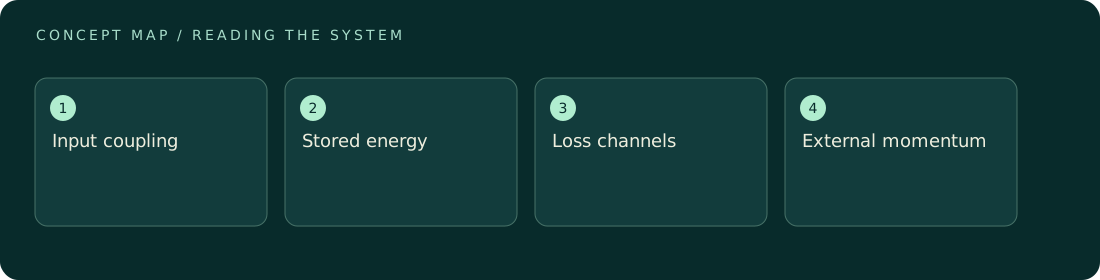
Use a consistent energy-decay convention and identify every coupling and loss channel. For local optomechanics, model the field at the moving surface. For whole-device force, draw an enclosing boundary and sum external momentum fluxes. Check transient storage whenever the measurement duration is comparable to filling or ringdown time.
Sources & context
These sources support the concepts noted below. Our synthetic examples and research framing are educational interpretation; they are not findings from these organizations or validation of our ventures.
- Finesse: Radiation pressure example ↗
Force-to-displacement frequency response; documentation opened.
Source check: Relevant excerpt or resource metadata checked; see support note. Original illustrative calculation, not source data.
Educational research context, not a validated device specification or clinical protocol. Read our editorial and correction policy.