
The essential answer
Optical power calibration establishes how a detector indication corresponds to incident power under specified conditions. The relevant quantity is usually power at the experimental interaction, not a laser's nominal output. Wavelength, beam size, incidence angle, polarization, detector temperature, and temporal structure can affect response. Losses between a monitor and the sample need their own measured transfer. Calibrated power is especially important when force or heating predictions scale directly with it, because a power error propagates directly into those predictions.
How to reason about it
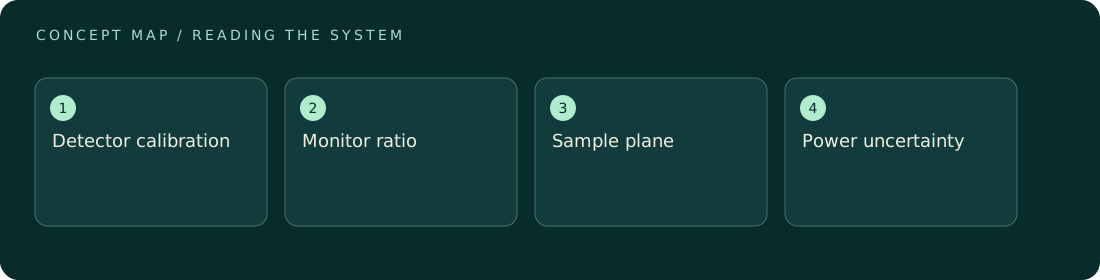
Start by defining whether the desired value is average power, pulse energy divided by repetition interval, peak power, or a modulated amplitude. A thermal detector may measure average power accurately while being unable to resolve fast modulation. A photodiode may resolve modulation but require a wavelength-specific responsivity and careful linearity checks. Attenuators and beam splitters have their own wavelength, angle, and polarization dependence. Transfer a calibration to the sample plane with a reproducible geometry, or use a monitor whose ratio to sample power has been measured. Account for clipping and detector apertures rather than assuming the whole beam is collected. Compare before and after the run to bound drift, and retain raw monitor data when possible. A certificate covers its stated conditions; it does not automatically cover an arbitrary pulsed waveform, overloaded detector, or changed optical train.
ILLUSTRATIVE · NOT A REPORTED RESULT
An example to work through
Assume a hypothetical monitor reads 20 mW and a measured splitter ratio sends 5.0 times that power to the sample, giving 100 mW. Let independent relative standard uncertainties be 1.0% for the monitor calibration and 2.0% for the ratio. The sample-power uncertainty is sqrt(1²+2²)% = 2.24%, or 2.24 mW. For ideal normal reflection, predicted force is 2P/c = 0.667 nN, with the same 2.24% relative contribution from power alone. Angle, reflectance, and force-sensor calibration add separate contributions to a comparison.
Where interpretation fails
A stable monitor ratio does not guarantee stable sample power if alignment changes downstream of the monitor. Likewise, average power cannot determine peak intensity without pulse duration and shape. Avoid mixing RMS modulation amplitudes, peak amplitudes, and average values when comparing optical and mechanical channels.
The next decision
Calibrate at the sample plane whenever practical and document the transfer when it is not. Check detector linearity, collection, wavelength setting, and temporal response at the intended operating point. Allocate uncertainty to the monitor-to-sample ratio and verify it after changes to optics, alignment, polarization, or attenuation.
Sources & context
These sources support the concepts noted below. Our synthetic examples and research framing are educational interpretation; they are not findings from these organizations or validation of our ventures.
- NIST: Photonic Power Metrology ↗
Further reading on optical power traceability; official search excerpt checked.
Source check: Relevant excerpt or resource metadata checked; see support note. Original illustrative calculation, not source data.
Educational research context, not a validated device specification or clinical protocol. Read our editorial and correction policy.