

The essential answer
Calibration determines the relationship between an indication and reference quantities, including uncertainty. Validation tests whether the complete method is suitable for its intended use. A sensor can have an excellent calibration and still produce a misleading experimental conclusion because the mounting, timing, background subtraction, or signal model is unsuitable. Conversely, a repeatable end-to-end demonstration does not establish an accurate scale factor by itself. Treat calibration and validation as complementary tasks with separate evidence and separately stated acceptance criteria.
How to reason about it
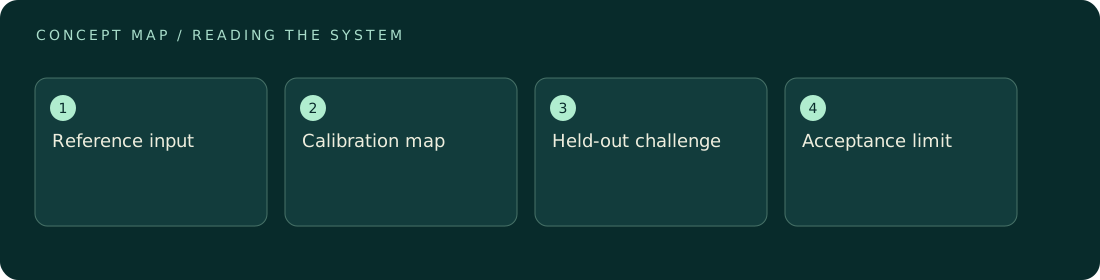
For a linear readout, calibration may estimate offset and sensitivity from applied reference forces. Residuals then test whether a straight line adequately describes the selected range. Validation goes further: can the assembled method recover an independently imposed signal with the relevant duration and direction under representative operating conditions? A static weight does not automatically validate a modulated optical-force measurement near a mechanical resonance. Use reference inputs that challenge the same processing steps as the intended signal, while preserving an independent basis for their value. Avoid using the same observations both to tune a correction and to claim that the correction works. Withhold an amplitude, operating point, or session for an independent check. Document failed checks as information about the method's domain, rather than forcing them into a universal calibration curve.
ILLUSTRATIVE · NOT A REPORTED RESULT
An example to work through
Assume an illustrative calibration gives 4 mV/nN and a 1 mV offset. A held-out 3 nN input should therefore give 13 mV. If the complete acquisition returns 11 mV, its converted estimate is (11−1)/4 = 2.5 nN, a −0.5 nN discrepancy. If the combined standard uncertainty of this comparison is 0.1 nN, the discrepancy is five standard uncertainties and demands investigation. Check whether filtering attenuates the test pulse before altering the static sensitivity. These numbers are a hypothetical diagnostic, not reported apparatus performance.
Where interpretation fails
A high coefficient of determination in a calibration fit is not proof of suitability. A wide input range can make R² impressive while small residual structure remains larger than the experiment's target signal. Plot residuals in force units and compare them with the intended uncertainty requirement.
The next decision
Accept a method for the stated use only after independent inputs spanning relevant amplitudes and timescales recover their reference values within a predeclared comparison tolerance. If validation fails only at one frequency or environment, narrow the operating domain explicitly and investigate the missing response term before extrapolating.
Sources & context
These sources support the concepts noted below. Our synthetic examples and research framing are educational interpretation; they are not findings from these organizations or validation of our ventures.
- VIM: calibration ↗
Calibration definition; opened definition and notes.
Source check: Relevant excerpt or resource metadata checked; see support note. Original illustrative calculation, not source data.
Educational research context, not a validated device specification or clinical protocol. Read our editorial and correction policy.