

The essential answer
Preservation extends through organizational change. People leave, systems change, and responsibilities may move between institutions. A continuity plan asks how stewardship can persist through those changes. NCI includes legacy planning within biospecimen governance. The educational lesson is that a durable container or storage medium is only one part of a long-term claim. The claim also depends on someone remaining able and authorized to interpret records, make decisions, and maintain the resource when its original arrangements no longer apply.
How to reason about it
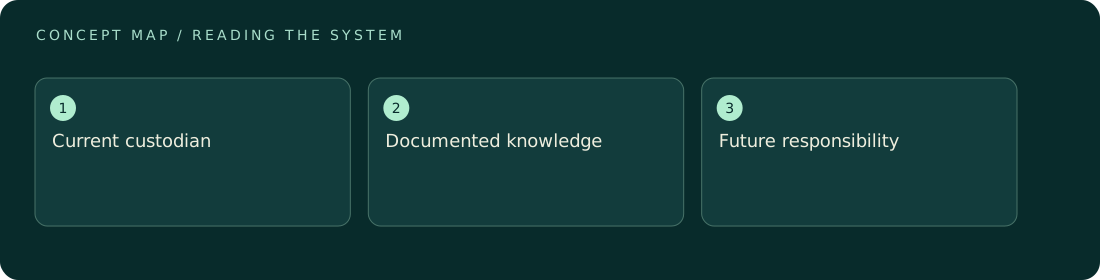
A continuity question differs from a prediction about how long a material could physically last. It asks whether the supporting institution can keep fulfilling its responsibilities over that period. Consider knowledge, authority, resources, and transfer arrangements as separate dependencies. A technically intact archive can become difficult to use if only one departing person understands its catalog. A well-funded program can still face confusion if responsibility for future decisions is unspecified. This framework does not certify any organization or suggest that a particular plan guarantees survival. It helps readers evaluate whether a preservation description acknowledges change instead of assuming permanent conditions. Strong descriptions identify responsibilities and limits in plain language, while uncertain future arrangements remain explicitly uncertain rather than being presented as completed commitments.
ILLUSTRATIVE · NOT A REPORTED RESULT
An example to work through
Imagine a fictional archive whose storage hardware is maintained, but whose catalog conventions exist only in one custodian's memory. Assume that custodian retires unexpectedly. The objects remain, yet interpreting some records becomes harder. Now imagine a second archive with documented conventions but no identified authority to approve a transfer. Its difficulty is different. The comparison shows why continuity is not one checklist item: knowledge and authority can fail independently. These scenarios are original teaching examples, not claims that any named organization has a succession plan or has failed to maintain one.
Where interpretation fails
Do not interpret a long storage horizon as a promise that an institution will operate unchanged for that entire period. Physical durability, financial continuity, and governance continuity are different matters. Avoid presenting intended arrangements as completed agreements or treating a written plan as proof that it has been exercised.
The next decision
When reading a long-term preservation claim, ask who remains responsible if the original arrangement changes. Look for interpretable records, documented authority, and candid limits on future commitments. Use these questions to evaluate the description, while leaving real governance decisions with the responsible institution and its qualified advisers.
Sources & context
These sources support the concepts noted below. Our synthetic examples and research framing are educational interpretation; they are not findings from these organizations or validation of our ventures.
- NCI Best Practices for Biospecimen Resources ↗
NCI governance overview explicitly includes legacy planning.
Source check: Official overview opened; scope and topic list reviewed.
Educational research context, not a validated device specification or clinical protocol. Read our editorial and correction policy.