

The essential answer
Preserving material does not itself answer who may use it or for what purpose. Consent scope concerns the activities described and agreed to in the relevant context. NCI links intended use and governance with participant information. This page offers a conceptual reading framework, not legal advice or a determination that any use is permitted. A useful review distinguishes storage, analysis, sharing, and future uses rather than assuming that agreement to one activity necessarily covers every other activity.
How to reason about it
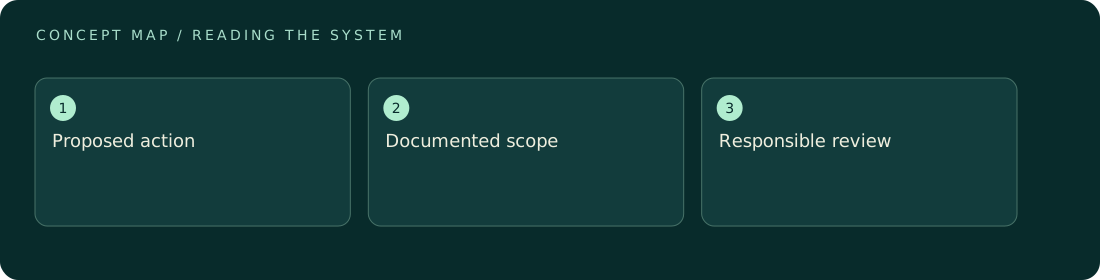
Permission questions become clearer when the proposed action is stated precisely. Keeping an item, studying it, linking it with other information, and transferring it to another group are different actions. Their relationship depends on the actual consent materials and governing institutional process. The educational point is not to supply universal rules, but to prevent vague language from doing too much work. A sentence such as available for research leaves unanswered what research, by whom, with which data, and under what conditions. A careful archive description should direct those questions to the relevant records and responsible reviewers. Uncertainty should be recorded as uncertainty; it should not be converted into permission merely because the material is technically accessible or scientifically interesting. The relevant records should remain accessible to authorized reviewers.
ILLUSTRATIVE · NOT A REPORTED RESULT
An example to work through
Imagine an invented archive description saying that contributors agreed to storage for Project Maple. A new proposal asks to share associated records with Project Cedar. Assume no additional consent wording is available to the reader. The correct conclusion is not that sharing is prohibited or permitted. It is that the available description does not resolve the new action. A reviewer can identify the difference between the two projects and request the relevant institutional determination. This hypothetical deliberately avoids a jurisdiction, legal standard, or contractual language, because those details would change a real assessment.
Where interpretation fails
Do not treat possession, technical access, or a broad project title as unrestricted authorization. Also avoid declaring a legal conclusion from an isolated phrase. A consent document exists within a wider institutional and regulatory context that a short educational example cannot reproduce or interpret conclusively.
The next decision
Describe the proposed use in concrete terms before asking whether it fits the documented scope. Locate the actual consent and governance records, and route unresolved questions to the responsible institution. For public communication, distinguish intended use from approved use and avoid promises about unrestricted future applications.
Sources & context
These sources support the concepts noted below. Our synthetic examples and research framing are educational interpretation; they are not findings from these organizations or validation of our ventures.
- Governance Best Practices ↗
NCI governance states that intended use should align with participant consent information.
Source check: Official governance overview opened; consent alignment and governance scope reviewed, not complete guidance.
Educational research context, not a validated device specification or clinical protocol. Read our editorial and correction policy.