
The essential answer
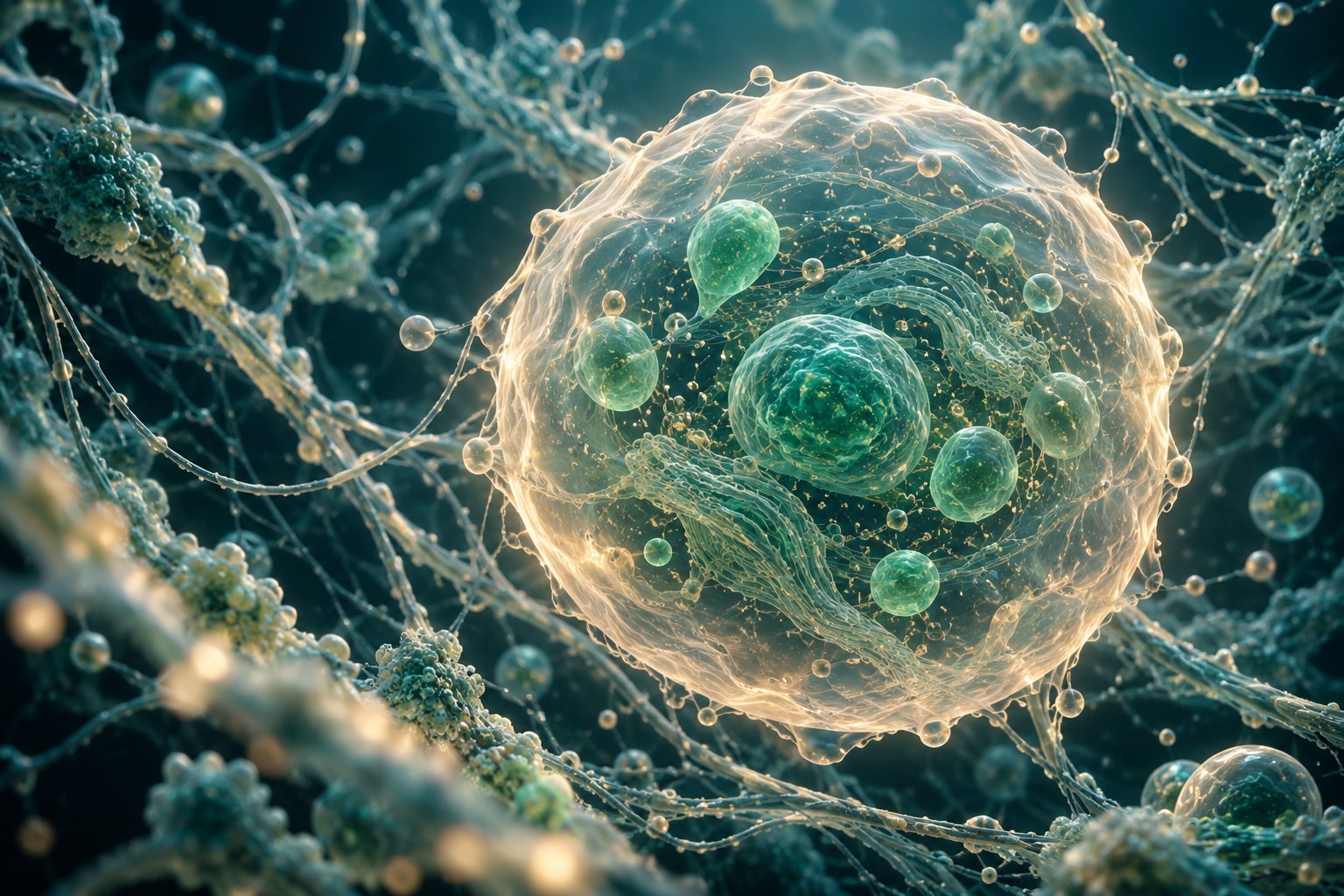
A compartment creates an inside and an outside, changing which components remain associated and which interactions are possible. Origins research studies how such boundaries might relate to chemical activity and reproduction. A compartment alone is not evidence of life: many nonliving structures have boundaries. The cited research examines a model linking molecular replication and compartment behavior. The broader lesson is to ask what the boundary does in the model, rather than assuming that a cell-like shape establishes a cell-like system.
How to reason about it
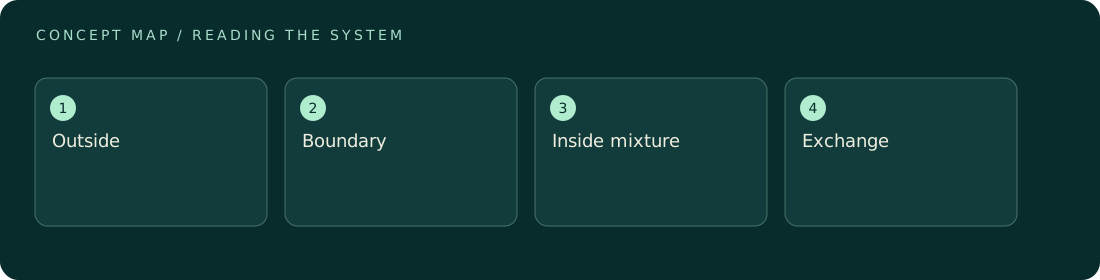
A boundary is best understood through its consequences. It can change the local context in which components encounter one another, but it can also create dependencies on exchange with the surroundings. A diagram that draws a circle around several molecules leaves these questions open unless the arrows and assumptions are specified. For a conceptual comparison, distinguish containment from selective exchange, and distinguish both from maintenance of the boundary itself. These are different functions even when one physical structure participates in all of them. A research model can isolate one function to make it easier to study. That simplification is useful, provided readers do not mistake the model for a complete explanation of an early cell or for evidence that the modeled setting actually occurred on early Earth.
ILLUSTRATIVE · NOT A REPORTED RESULT
An example to work through
Assume a toy diagram contains two kinds of tokens, blue and orange. In one version, all tokens occupy a shared space. In another, they are grouped into separate circles. The same total token count can now correspond to different local mixtures. A circle containing only blue tokens differs from a circle containing both colors, even when the overall totals are unchanged. This bookkeeping example explains why grouping can matter without specifying any chemistry. It does not show that the circles reproduce, maintain themselves, or represent living systems; those would require separate evidence.
Where interpretation fails
Do not use a membrane-like outline as a shortcut to the word cell. Containment, exchange, chemical activity, and reproduction are separate properties. Also remember that a model's boundary may be imposed by researchers or by a mathematical assumption, rather than maintained by the modeled system itself.
The next decision
When reading a compartment model, ask what crosses the boundary, what remains associated, and which behavior depends on that arrangement. Identify whether the boundary is an experimental condition or a property under investigation. Keep the model's demonstrated function separate from claims about complete living systems.
Sources & context
These sources support the concepts noted below. Our synthetic examples and research framing are educational interpretation; they are not findings from these organizations or validation of our ventures.
- Autonomous model protocell division driven by molecular replication ↗
Research excerpt concerns compartmentalization of a molecular self-replicator and model protocell division.
Source check: Research search excerpt reviewed; full-text open failed.
Educational research context, not a validated device specification or clinical protocol. Read our editorial and correction policy.