

The essential answer
Chemical oscillation is repeated change in a system's chemical state over time. It can arise from reaction networks without demonstrating a living organism. The Whitesides research group describes an oscillating network as a model relevant to origins questions. The important interpretive point is that periodic behavior and life are not synonymous. A rhythm may reveal feedback and changing conditions, while leaving maintenance, heredity, and evolutionary capacity unresolved. Describing the measured oscillation precisely is more useful than assigning it biological purpose.
How to reason about it
A repeating curve can support several different descriptions depending on what was observed. It might show a measured signal, a model variable, or a processed indicator. A reader should identify which one before interpreting the curve. The cause of repetition also matters: a system can respond to a repeating external input, or a network can generate repeating behavior under a stated input regime. These are different explanations even if the resulting traces look similar. A conceptual graph should therefore label both the plotted quantity and the assumptions about the surroundings. The presence of peaks alone does not establish regulation, reproduction, or an internal biological clock. The most informative question is what mechanism accounts for the timing and how competing explanations could be distinguished.
ILLUSTRATIVE · NOT A REPORTED RESULT
An example to work through
Assume a fictional graph has peaks at times 2, 4, 6, and 8 in arbitrary units. The interval between adjacent peaks is two units. That arithmetic describes periodicity in the displayed sequence, but it does not identify a mechanism. A second panel reveals that an external signal also repeats every two units. A third possible model produces similar peaks under a steady input. Without further evidence, the first graph cannot distinguish these explanations. This invented example contains no measured chemistry, operational settings, or claim that the pattern is a biological rhythm.
Where interpretation fails
Do not infer intention from regularity. Phrases such as the system knows when to act can obscure the mechanism. Also avoid interpreting a few visually similar peaks as proof of stable long-term behavior without considering the duration of observation, noise, and the plotted quantity's definition.
The next decision
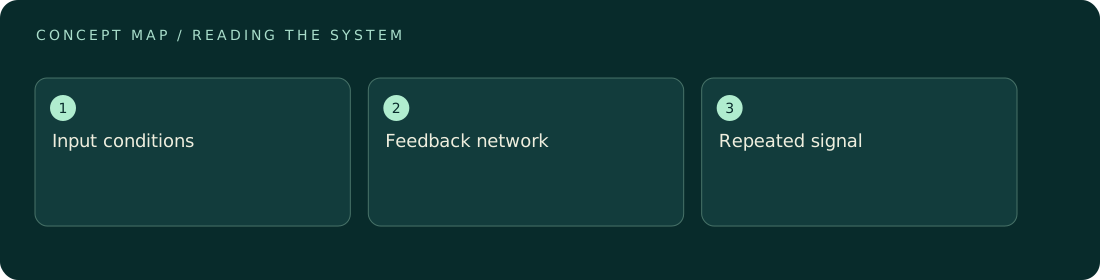
When reading an oscillation claim, identify the signal, time axis, input conditions, and proposed feedback. Ask whether the explanation distinguishes internally generated behavior from a response to external cycling. Treat any further claim about life or biological control as a separate proposition requiring additional evidence.
Sources & context
These sources support the concepts noted below. Our synthetic examples and research framing are educational interpretation; they are not findings from these organizations or validation of our ventures.
- The Chemical Origins of Life ↗
The originating research group describes oscillations in a chemical reaction network under continuous flow.
Source check: Originating research group page opened; network description reviewed.
Educational research context, not a validated device specification or clinical protocol. Read our editorial and correction policy.