

The essential answer
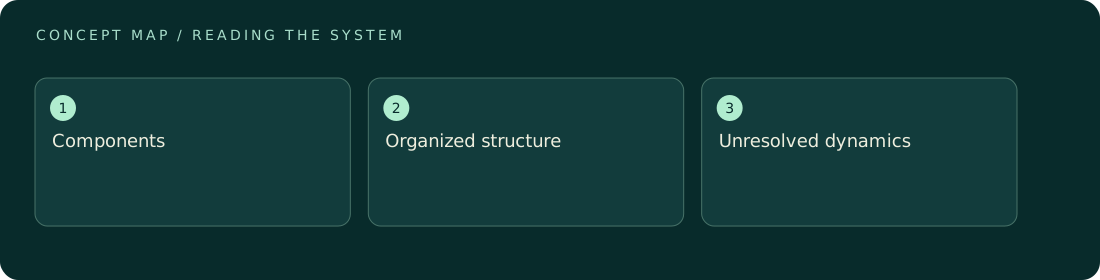
Self-assembly describes components organizing into a structure through their interactions. It does not by itself establish a living system. Structure, maintenance, reproduction, and evolutionary capacity are different questions. NASA's discussion of life emphasizes that a definition needs more than a familiar appearance. The educational distinction is therefore between the formation of order and the continued behaviors associated with life. A striking structure can be scientifically interesting while leaving questions about function, inheritance, and sustained activity entirely open.
How to reason about it
An ordered endpoint tells a reader that a particular arrangement formed under particular circumstances. It does not tell the reader how the arrangement responds to disturbance, whether it can sustain relevant processes, or whether descendants inherit differences. Those are questions about dynamics and history. A photograph may be excellent evidence for shape while being poor evidence for a lineage. Conversely, a system need not look visually elaborate to exhibit meaningful dynamics. Separating these evidence types helps prevent aesthetic judgments from becoming biological conclusions. In an origins context, self-assembly can be considered as one possible contribution to a larger scenario. The burden is then to explain how that contribution connects with other necessary properties, rather than treating the presence of order as the conclusion of the entire argument.
ILLUSTRATIVE · NOT A REPORTED RESULT
An example to work through
Picture a hypothetical display in which identical pieces settle into a repeating pattern. Assume the pieces interact without a person placing each one individually. That supports a claim of self-organization in the model. Now ask whether one pattern produces descendants with inherited differences, or whether the system maintains its organization while exchanging resources. The original observation does not answer either question. A learner can admire the pattern and still mark these fields as unknown. This example uses abstract pieces rather than a biological recipe and makes no claim that an actual material system is alive.
Where interpretation fails
Avoid using complexity or beauty as a proxy for life. A pattern's appearance can tempt observers to attribute purpose or agency that the evidence does not establish. The opposite shortcut also fails: a simple-looking system may support important processes that are invisible in a still image.
The next decision
Describe the observed organization first, then list the additional behaviors needed for the claim being considered. Match each behavior to an appropriate kind of evidence. Use self-assembly as a specific description of structure formation, and reserve broader conclusions for a clearly stated framework with supporting observations.
Sources & context
These sources support the concepts noted below. Our synthetic examples and research framing are educational interpretation; they are not findings from these organizations or validation of our ventures.
- How can we tell if something is alive or not? ↗
NASA definition discussion supports separating appearance from broader life criteria; the example is original.
Source check: Official educational page opened; definition and limitations reviewed.
Educational research context, not a validated device specification or clinical protocol. Read our editorial and correction policy.