
The essential answer
Synthetic and minimal describe different aspects of a system. Synthetic can refer to designed or synthesized components; minimal concerns reducing components under specified conditions. A cell with a synthetic genome is not necessarily assembled entirely from nonliving raw materials, and a reduced genome is not a universal inventory for every environment. JCVI reports a minimal synthetic bacterial cell, while NIST explains that the earlier synthetic-genome work relied on existing cellular machinery. The labels need context rather than a single dramatic interpretation.
How to reason about it
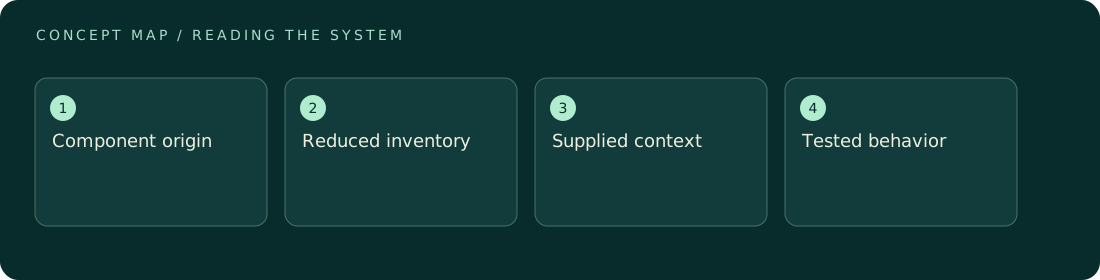
One axis asks about origin of components: which parts were designed, synthesized, inherited, or supplied? Another asks about necessity: which components are required for the particular behavior and conditions under study? These axes should not be collapsed. A system can have a designed component and still depend on many pre-existing structures. A system can be minimal relative to one supportive environment while requiring additional capabilities elsewhere. The research value lies in making those dependencies easier to investigate, not in proving a universal smallest possible life form. A careful description names the criterion used for minimality and the scope of synthesis. It also separates demonstrated behavior from future goals, because a simplified model can expose unanswered questions as well as clarify known relationships.
ILLUSTRATIVE · NOT A REPORTED RESULT
An example to work through
Imagine an abstract machine with a newly designed instruction card placed into an existing mechanism. Calling the card synthetic does not mean the gears, power supply, and housing were newly built. Now imagine removing parts until the machine performs one specified task in a protected setting. That could make it minimal for that task, but not necessarily for travel or operation outdoors. The analogy is deliberately nonbiological. It helps a learner keep construction history and functional reduction separate, without suggesting a recipe for making cells or declaring that any actual organism is universally minimal.
Where interpretation fails
Avoid headlines that turn a synthetic genome into creation of every cellular component from scratch. Likewise, avoid reading minimal as simplest under all possible conditions. The terms become informative only when the supplied environment, tested behavior, and retained or inherited machinery are clearly described.
The next decision
Ask two questions separately: what was synthesized, and minimal for which function under which conditions? Look for explicit dependencies and remaining unknowns. Describe the result using those answers, and keep proposed applications distinct from capabilities actually demonstrated by the cited research program.
Sources & context
These sources support the concepts noted below. Our synthetic examples and research framing are educational interpretation; they are not findings from these organizations or validation of our ventures.
- First Minimal Synthetic Bacterial Cell ↗
JCVI documents a reduced synthetic-genome cell; construction-context distinction is supported by the additional NIST report.
Source check: Originating institute research page opened. - Scientists Develop Cell With Synthetic Genome That Grows and Divides Normally ↗
NIST explicitly states that the synthetic-genome cell was not built completely from scratch.
Source check: Official participating institution report opened and reviewed.
Educational research context, not a validated device specification or clinical protocol. Read our editorial and correction policy.