

The essential answer
There is no single definition that resolves every difficult case. A working definition helps researchers specify which properties they are investigating. NASA discusses a chemical system capable of sustaining itself and undergoing Darwinian evolution, while acknowledging difficulties with the definition. For learning, the useful move is to replace a vague alive-or-not argument with explicit questions about maintenance, reproduction, heredity, and environment. A definition organizes evidence; it does not make missing evidence appear or settle the history of life's origin.
How to reason about it
Definitions perform different jobs. A classroom definition helps distinguish familiar examples. A research definition helps decide which observations would support a claim. A mission-oriented definition may be shaped by what instruments can detect. These purposes overlap without being identical. System boundaries also matter: a process that looks self-sustaining inside one drawn box may rely on essential support outside it. That does not automatically disqualify it, because living systems exchange matter and energy with their environments. It does mean the support must be described. A careful discussion therefore names the boundary, the relevant timescale, and the properties under consideration. Instead of forcing every borderline example into an immediate yes or no, a learner can describe which criteria are met, unresolved, or inapplicable.
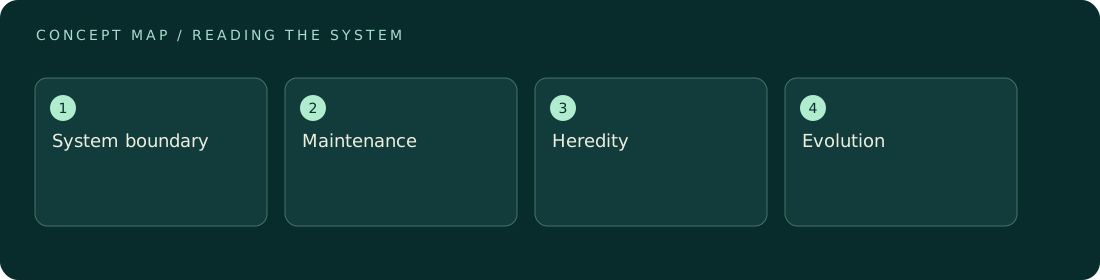
ILLUSTRATIVE · NOT A REPORTED RESULT
An example to work through
Imagine two fictional exhibits. Exhibit A shows a repeating chemical pattern; Exhibit B shows a lineage whose inherited differences affect later representation. Assume the descriptions are accurate but incomplete. A working definition emphasizing evolution would ask different follow-up questions of the two exhibits than a definition emphasizing visible activity. Neither exhibit can be judged solely by how animated it looks. The exercise is to write a property map and mark the missing evidence. These are hypothetical descriptions, not reports of constructed organisms or claims that either exhibit has crossed a universal boundary into life.
Where interpretation fails
Avoid treating a working definition as a universally agreed test with no exceptions. Also avoid treating disagreement over definitions as proof that scientific investigation is impossible. Researchers can compare specific properties and predictions even when the broad category remains difficult at its edges.
The next decision
Before asking whether a system is living, state the working definition and the boundary of the system. Identify observations relevant to each criterion and label uncertainties. Use the definition consistently, while remaining open to revising it if it obscures rather than clarifies the scientific question.
Sources & context
These sources support the concepts noted below. Our synthetic examples and research framing are educational interpretation; they are not findings from these organizations or validation of our ventures.
- How can we tell if something is alive or not? ↗
NASA presents a working definition and acknowledges its difficulties.
Source check: Official educational page opened; definition and limitations reviewed.
Educational research context, not a validated device specification or clinical protocol. Read our editorial and correction policy.