

The essential answer
Energy flux concerns transfer over time, while stored energy is an amount. A system can have an energy store without a continuing supply, or receive a supply while dissipating energy. Origins models that describe sustained activity need to account for these flows and their coupling to processes. The cited light-driven replicator study provides a research context for externally driven dynamics. The educational lesson is to distinguish amounts, rates, and useful transformations instead of treating the word energy as a complete explanation.
How to reason about it
A balance statement provides a disciplined starting point: change in the stored amount equals what enters minus what leaves, under the chosen boundary and accounting assumptions. This does not by itself explain a mechanism, but it prevents an explanation from ignoring inputs or outputs. A steady stored amount can coexist with substantial flows when incoming and outgoing rates balance. Conversely, a rising amount does not establish that the stored energy is being used for maintenance or reproduction. Those are separate functional questions. In an origins discussion, identify both the accounting and the mechanism. A conceptual flow diagram should not be mistaken for measured data, and a model with balanced arrows should not be mistaken for a demonstrated self-sustaining organism. Both deserve explicit treatment in any explanatory caption.
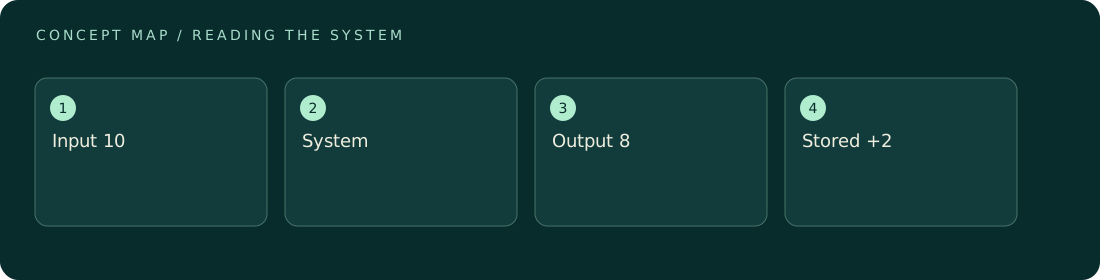
ILLUSTRATIVE · NOT A REPORTED RESULT
An example to work through
Assume an imaginary system receives ten energy units per interval and releases eight, with no other transfers. Its stored amount increases by two units per interval. In a second scenario it receives ten and releases ten, so its stored amount is unchanged even though energy continues to pass through. These arithmetic examples use invented units and omit all chemical detail. They show why a flat storage curve does not mean nothing is happening. Neither scenario establishes useful work, metabolism, or life; those claims would require an explanation of what the transfers actually support.
Where interpretation fails
Do not confuse zero net accumulation with zero activity. Equal input and output can conceal large ongoing flows. Also avoid comparing an energy amount with a transfer rate as though they had the same units, or inferring biological function from an energy balance alone.
The next decision
Write down the system boundary, time interval, inputs, outputs, and stored amount before interpreting an energy diagram. Check that quantities have compatible units. Then ask how the flows connect to the claimed behavior, keeping accounting consistency separate from evidence for a particular biological or prebiotic mechanism.
Sources & context
These sources support the concepts noted below. Our synthetic examples and research framing are educational interpretation; they are not findings from these organizations or validation of our ventures.
- Light-driven eco-evolutionary dynamics in a synthetic replicator system ↗
The research concerns light-driven dynamics of a synthetic replicator; balance examples are original, not study data.
Source check: Research search excerpt reviewed; full-text open failed.
Educational research context, not a validated device specification or clinical protocol. Read our editorial and correction policy.