

The essential answer
Model selection chooses an approximation for a defined purpose under available evidence and constraints. There is no universally best model independent of the prediction task, data regime, and cost of errors. Compare plausible candidates with a fixed evaluation procedure, a meaningful metric, and an explicit complexity or operational burden. Separate the data used to choose a model from the data used for its final performance claim. Prefer a model whose limitations can be understood and tested over one whose apparent advantage depends on repeated inspection of the same test set.
How to reason about it
Define the intended output and acceptable failure modes before selecting a model family. A model that estimates an average accurately may be unsuitable for predicting extremes. A flexible empirical fit can be useful inside a rich data domain while a mechanistic model may offer stronger constraints in a sparse regime; either can fail if its assumptions are wrong. Evaluate competing candidates on common splits that respect groups and time. Use development data to tune complexity and retain independent evidence for final assessment. Inspect residuals and physical constraints alongside aggregate scores. If candidate rankings fluctuate across reasonable splits, the evidence may not support a strong preference. Consider computation, observability, calibration burden, and ease of updating as part of the decision. Document the candidate set and search process, because a winning score selected from hundreds of attempts is not equivalent to a prespecified comparison between two models.
ILLUSTRATIVE · NOT A REPORTED RESULT
An example to work through
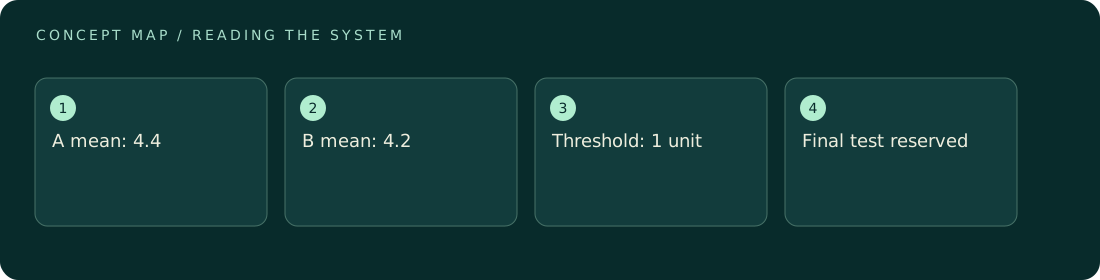
Suppose two invented candidates are compared on five development folds using the same error metric. Model A has errors 4, 5, 4, 5, and 4, averaging 4.4. Model B has 3, 6, 3, 6, and 3, averaging 4.2. B improves the average by 0.2 units but varies more across these folds. If A is simpler and the practical improvement threshold was one unit, these results alone do not justify replacing A. A reserved final test set remains unused until the choice is fixed. This example is a decision illustration, not a statistical significance calculation or a claim about real models.
Where interpretation fails
Repeatedly selecting the model with the best test score turns the test set into development data. Another trap is adding complexity to explain every residual without asking whether the added terms remain identifiable and stable. A tiny numerical improvement may disappear under a new split or operating regime.
The next decision
Choose the least burdensome candidate that meets the prespecified performance and physical requirements with credible evidence. If alternatives are effectively tied, report that uncertainty and use maintainability or interpretability to decide. Reserve stronger claims of superiority for improvements that survive an evaluation design independent of the selection process.
Sources & context
These sources support the concepts noted below. Our synthetic examples and research framing are educational interpretation; they are not findings from these organizations or validation of our ventures.
- scikit-learn: Cross-validation ↗
Model tuning and final testing require separation.
Source check: Official documentation opened; evaluation procedure inspected.
Educational research context, not a validated device specification or clinical protocol. Read our editorial and correction policy.