

The essential answer
Leakage occurs when model development uses information that would be unavailable for the intended prediction. It can enter through feature construction, preprocessing, sample selection, repeated entities, or repeated consultation of the test score. A clean train-test boundary must apply to the entire workflow, not just the final fitting call. Define what is known at prediction time and what constitutes an independent future case. Then choose a split and processing procedure that simulate that use closely enough to support the performance claim.
How to reason about it
Start with a deployment story: predict a new specimen, a later measurement of an existing device, or a result at a new site. These are different tasks and can require different evaluation splits. If several rows come from one specimen, a random row split may let the model recognize specimen-specific information instead of learning transferable behavior. For forecasting, measurements recorded after the prediction time cannot become features just because they appear in the same table. Fit scalers, imputers, feature selectors, and other learned transformations using only the training portion of each evaluation fold. Preserve a final evaluation set that does not influence model choice. An audit is easiest when every feature has a provenance record indicating its source and availability time. This also exposes proxies for the target, such as a post-test inspection field created only after a failure was known.
ILLUSTRATIVE · NOT A REPORTED RESULT
An example to work through
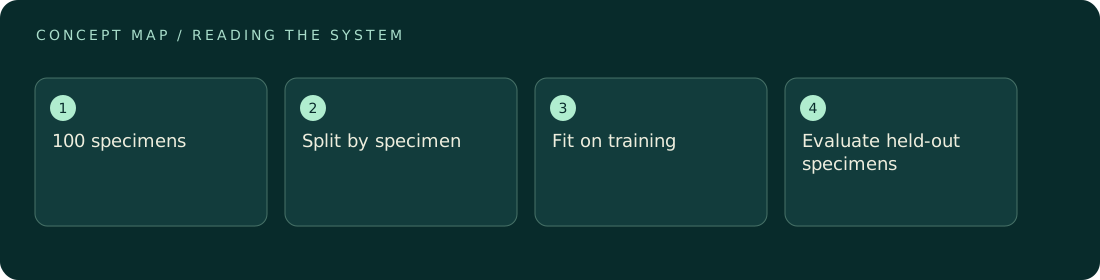
Imagine 100 fabricated specimens, each measured ten times, giving 1000 rows. A random eighty-twenty row split can place readings from almost every specimen in both sets. If the intended use is prediction on unseen specimens, that split tests the wrong question. A specimen-level split instead assigns 80 complete specimens to training and 20 complete specimens to testing, yielding 800 and 200 rows with no specimen overlap. A normalization mean is then estimated from the 800 training rows only. These counts describe an illustrative design; no claim about a measured improvement or score is being made.
Where interpretation fails
A pipeline can correctly separate preprocessing and still leak through the data design. Duplicate specimens, shared batches, future timestamps, or outcome-derived columns may cross the boundary before the pipeline sees the data. Conversely, a lower score after fixing leakage is more credible evidence, not evidence that the correction harmed the model.
The next decision
Before interpreting a test metric, verify independence at the level required by the deployment question and audit feature availability. Rebuild the evaluation if target information or shared identities crossed the boundary. Keep the contaminated score only as a documented diagnostic; it cannot serve as the final estimate of generalization.
Sources & context
These sources support the concepts noted below. Our synthetic examples and research framing are educational interpretation; they are not findings from these organizations or validation of our ventures.
- scikit-learn: Common pitfalls ↗
Learn preprocessing using training data only.
Source check: Official documentation opened; leakage section inspected.
Educational research context, not a validated device specification or clinical protocol. Read our editorial and correction policy.