

The essential answer
A baseline is a deliberately simple reference against which a more elaborate model must earn its usefulness. It may be a constant predictor, a persistence forecast, a simple physical balance, or an established operational rule. Choose it to match the task rather than to be easy to beat. Evaluate baseline and candidate on the same cases with the same metric and information available. A baseline creates a practical question: does added complexity improve a consequential outcome enough to justify its maintenance, interpretation, and computational costs?
How to reason about it
Several baselines can answer different questions. A constant predictor tests whether features contribute information beyond the response distribution. A persistence model tests whether a forecast improves on the latest observation. A simple mechanistic model tests whether a flexible fit adds value beyond known structure. Keep preprocessing and evaluation conditions comparable, and include the baseline in error breakdowns across operating regimes. An average improvement can hide a region where the complex model fails badly. The baseline should also be specified before looking at final test results, otherwise its design can become another tuned comparison. When a candidate barely outperforms a cheap, stable reference, quantify the uncertainty of that difference and the operational consequences. The result may justify further development rather than immediate replacement. A baseline is most useful when it remains executable and versioned alongside the candidate throughout the project.
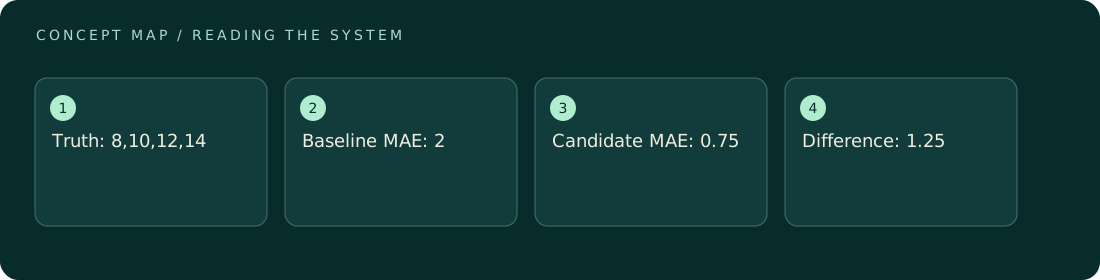
ILLUSTRATIVE · NOT A REPORTED RESULT
An example to work through
Take four invented held-out values: 8, 10, 12, and 14 units. Assume the training mean is 11, so a constant baseline predicts 11 each time. Its absolute errors are 3, 1, 1, and 3, giving mean absolute error 2. A candidate predicts 9, 10, 11, and 13; its errors are 1, 0, 1, and 1, giving mean absolute error 0.75. The difference is 1.25 units on these four cases. This small worked example illustrates metric calculation only. Four selected cases cannot establish robust superiority, and the training mean must not be replaced with a value chosen using the held-out outcomes.
Where interpretation fails
An intentionally weak comparator can make an ordinary model look impressive. Also avoid comparing one model's training error with another model's test error, or changing the metric after seeing which one favors the preferred method. A baseline that uses unavailable information is no more valid than a leaking candidate.
The next decision
Retain the simpler model unless the candidate shows meaningful, credible improvement under the intended use conditions. If the new model wins only in a narrow regime, consider a restricted role instead of wholesale replacement. Document the comparator, shared evaluation set, metric, and cost of complexity with the performance difference.
Sources & context
These sources support the concepts noted below. Our synthetic examples and research framing are educational interpretation; they are not findings from these organizations or validation of our ventures.
- scikit-learn: Metrics and scoring ↗
Dummy estimators provide reference prediction strategies.
Source check: Official documentation opened; relevant evaluation guidance inspected.
Educational research context, not a validated device specification or clinical protocol. Read our editorial and correction policy.