

The essential answer
A usable requirement states what a system must do or constrain under specified conditions in terms that can be assessed. It connects a stakeholder need to an observable outcome without unnecessarily prescribing the implementation. Include enough context to distinguish success from failure, and preserve the rationale separately so future changes can be evaluated intelligently. A requirement is not complete merely because it contains a number or the word shall. The quantity, conditions, scope, and planned evidence must make the obligation understandable to both builder and reviewer.
How to reason about it
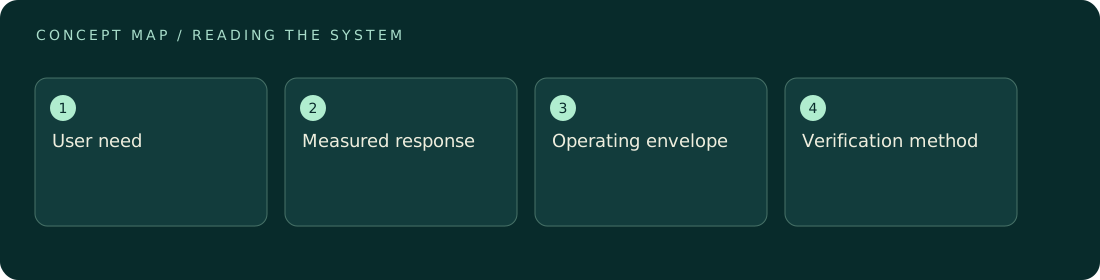
Start from the user outcome and identify the system boundary responsible for delivering it. Replace vague adjectives such as fast, robust, or accurate with a defined response and relevant operating envelope. Specify whether the limit applies to every case, an average, a percentile, or a stated fraction of cases. Then identify a feasible verification method and the equipment or analysis needed to apply it. Avoid merging several independent obligations into one sentence because partial compliance becomes difficult to track. Maintain links to the originating need and to lower-level requirements, while checking that allocations do not introduce contradictions. A change in intended use can invalidate a previously reasonable threshold, so version requirements alongside the design. The aim is a shared decision basis that survives staff changes and test surprises, not a large document that nobody can turn into evidence.
ILLUSTRATIVE · NOT A REPORTED RESULT
An example to work through
Suppose a fictional sample stage must support a time-sensitive measurement. The phrase move quickly is replaced with: after a commanded 10 mm move at a specified 2 kg payload and room-temperature range, position error shall remain within 0.05 mm within 0.5 s. This defines distance, load, environment, error, and settling time. A verification plan still needs sampling bandwidth and the duration for which the error must remain within the band. If the stage briefly crosses the band at 0.4 s and exits at 0.45 s, that crossing alone is not settling. The worked diagnostic exposes an ambiguity before hardware acceptance.
Where interpretation fails
Overly specific requirements can freeze an implementation before its tradeoffs are understood. The opposite mistake is an attractive performance number without conditions, such as an accuracy limit that omits load or temperature. Both create disputes because different teams can satisfy different interpretations of the same written statement.
The next decision
Approve a requirement when the responsible team and reviewer can independently describe the same pass condition and a feasible way to observe it. If they disagree, clarify the quantity or conditions before design commitment. Preserve the underlying need so that a later proposed relaxation can be assessed against its real consequence.
Sources & context
These sources support the concepts noted below. Our synthetic examples and research framing are educational interpretation; they are not findings from these organizations or validation of our ventures.
- NASA: Technical Requirements Definition ↗
Technical requirements translate stakeholder expectations into assessable constraints.
Source check: Official handbook HTML opened.
Educational research context, not a validated device specification or clinical protocol. Read our editorial and correction policy.