

The essential answer
A battery releasing stored energy demonstrates an energy-conversion process. Metabolism refers to organized chemical transformations in living systems, linked to their maintenance and other functions. Origins research sometimes studies partial analogues of such networks, but an energy signal alone does not establish metabolism or life. The cited research group's network model is useful for exploring relationships among reactions. The teaching distinction is between energy being released and energy-related processes being integrated with the continuing organization of a system.
How to reason about it
The comparison becomes clearer when the system boundary and duration are stated. A device may operate for a while by consuming a finite store without replacing or maintaining its own components. A biological description typically asks how material and energy transformations relate to a wider set of functions. This does not mean every metabolic process is self-sufficient in isolation; living systems depend on their environments. Instead, it means the explanation must account for relationships among processes. A single falling energy curve leaves those relationships unspecified. In a conceptual origins model, ask which functions are represented and which are supplied externally or omitted. Calling a model metabolism-like can be useful if the resemblance is named precisely and not expanded into an assertion that the model is a complete organism.
ILLUSTRATIVE · NOT A REPORTED RESULT
An example to work through
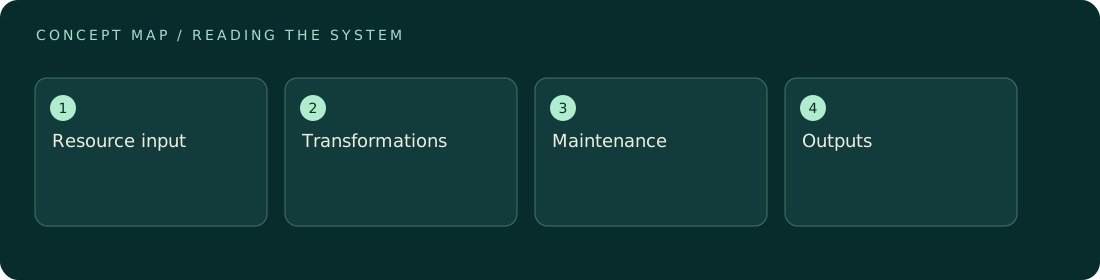
Assume an imaginary device begins with 12 energy tokens and spends three per round. Without replenishment it can support four rounds, because 12 divided by 3 equals 4. Observing activity during those rounds does not establish self-maintenance. Now imagine a second diagram with incoming resources, transformations, outgoing products, and a separate maintenance requirement. That diagram raises richer questions, but arrows alone do not prove they are satisfied. The example is a bookkeeping analogy with invented tokens; it is not a biochemical model or evidence that a constructed system has metabolism.
Where interpretation fails
Avoid calling every energy-releasing reaction metabolic. The label should not replace an explanation of the network and its functions. Equally, avoid demanding complete independence from the environment as the definition of metabolism; dependence on surroundings must be described rather than treated as an automatic disqualification.
The next decision
Ask what the observed energy change supports, what resources are consumed, and how the system's organization is maintained. Distinguish a finite stored-energy demonstration from a sustained network model. Keep the claimed resemblance to metabolism specific, and identify the functions that remain outside the model.
Sources & context
These sources support the concepts noted below. Our synthetic examples and research framing are educational interpretation; they are not findings from these organizations or validation of our ventures.
- The Chemical Origins of Life ↗
The research group uses reaction networks as elemental models; the battery comparison is original conceptual reasoning.
Source check: Originating research group page opened; network description reviewed.
Educational research context, not a validated device specification or clinical protocol. Read our editorial and correction policy.