

The essential answer
Voltage describes energy transferred per unit charge, not a reservoir size or a delivery rate. A voltmeter can show a substantial potential difference while drawing almost no current. To establish electrical output, measure voltage and current together at a specified load. Their product is instantaneous power, and accumulating that power over time gives transferred energy. A useful report therefore names the load, duration, initial condition, and measurement boundary alongside the voltage. A voltage trace alone leaves these questions unresolved.
How to reason about it
Imagine two sealed boxes with identical terminal voltages. One contains a small charged capacitor; the other contains a much larger electrochemical store. An almost open-circuit measurement may make them look equivalent, although their loaded behavior differs dramatically. Connecting a load asks a different physical question: how much charge can move while the source maintains useful terminal conditions? For direct current, compute P = VI with consistent signs. For varying signals, evaluate the product at each time, rather than multiplying two unrelated averages. Then integrate over the complete observation window. Include negative power if the device absorbs energy during part of the cycle. This procedure distinguishes potential, rate, and quantity without needing to guess the source mechanism. It also makes clear why a high-impedance meter is a probe of potential rather than a demonstration of sustained supply.
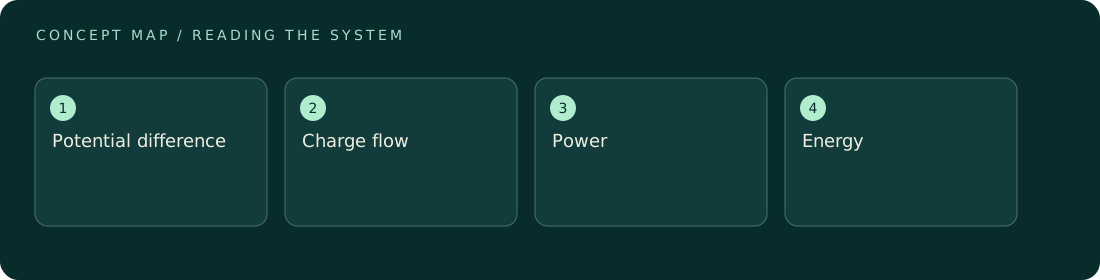
ILLUSTRATIVE · NOT A REPORTED RESULT
An example to work through
Assume a hypothetical source maintains 0.50 V across a 1,000 ohm resistor for 600 seconds, with resistance constant and wiring losses neglected. Current is 0.50/1,000 = 0.00050 A. Power is 0.00025 W, or 0.25 mW. Delivered energy is 0.00025 × 600 = 0.15 J. A second box showing the same 0.50 V without a connected load has no established output energy. If its voltage collapses when the resistor is attached, the first calculation cannot be applied to it. These numbers are a constructed comparison, not device measurements.
Where interpretation fails
Calling a reading “generated energy” skips the current and duration measurements. Another error is reporting the meter input current as if it represented an intended application load. Always distinguish open-circuit potential from voltage under load, especially for weak, high-resistance, or transient sources.
The next decision
Use voltage alone to check polarity or detect a state change. Use simultaneous loaded voltage and current to evaluate power. Use the time integral of that power to compare energy delivery. If only a voltage trace exists, narrow the conclusion to an electrical potential observation.
Sources & context
These sources support the concepts noted below. Our synthetic examples and research framing are educational interpretation; they are not findings from these organizations or validation of our ventures.
- Circuits and Electronics — MIT OpenCourseWare ↗
Official course context for elementary circuit analysis; calculations and diagnostic protocols here are original.
Source check: Official course search excerpt reviewed; no lecture-level validation claimed.
Educational research context, not a validated device specification or clinical protocol. Read our editorial and correction policy.