

The essential answer
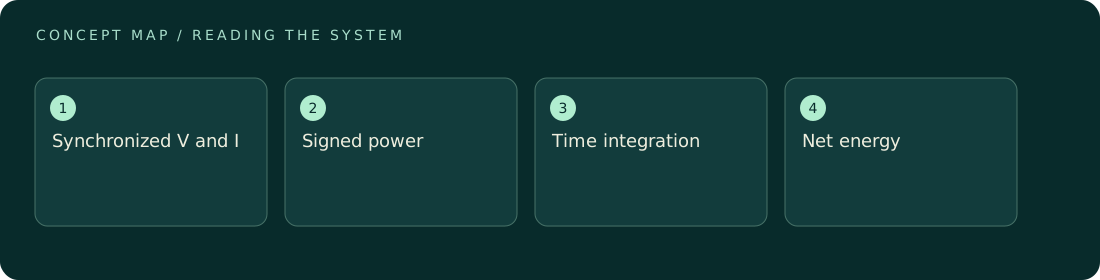
Energy transferred through an electrical port is the time integral of instantaneous power. For sampled data, calculate voltage times current at matching timestamps, then integrate using a stated numerical rule. A power peak says little about total energy without its width and the surrounding trace. Include startup, shutdown, and reverse-flow intervals when they belong to the claim. Report the integration window and sign convention so someone else can reconstruct the result and distinguish gross delivery from net electrical exchange.
How to reason about it
For piecewise constant readings, multiply each power by the interval it represents and sum. For smoothly changing samples, the trapezoidal rule uses the average of neighboring powers times the elapsed time. Irregular sampling requires actual timestamp differences, not a nominal interval. Missing data are not automatically zero power; they are missing information that may require bounds or a repeated run. Synchronization matters because a delayed current channel multiplied by a voltage transient can create a false energy contribution. Offsets also accumulate: a tiny persistent baseline error may dominate a long low-power test. Before integrating, inspect channel zeros, units, calibration, saturation, and the physical direction assigned to positive current. Finally, compare the cumulative-energy curve with the raw trace to catch unit conversions and discontinuities that a single final number would conceal.
ILLUSTRATIVE · NOT A REPORTED RESULT
An example to work through
Assume a constructed power record is exactly constant at 2 mW for 100 seconds, 1 mW for the next 200 seconds, and −0.5 mW for the final 100 seconds. Positive sign means delivery to the external circuit. The contributions are 0.20 J, 0.20 J, and −0.05 J, so net delivery is 0.35 J. Gross positive delivery is 0.40 J. Reporting only the first two intervals overstates net exchange by 0.05 J. The calculation assumes no unobserved transitions and that all three intervals belong to the same defined test.
Where interpretation fails
Multiplying average voltage by average current can fail when the channels vary together. Integrating absolute power also converts absorption into apparent generation. Neither shortcut is appropriate for a bidirectional energy balance unless the resulting quantity is explicitly labeled and its limited purpose explained.
The next decision
Keep the raw synchronized channels and compute signed power before integration. Show cumulative energy when startup or cycling matters. If data gaps or offset uncertainty could change the conclusion, provide a defensible interval or repeat the measurement instead of reporting an unjustifiably precise total.
Sources & context
These sources support the concepts noted below. Our synthetic examples and research framing are educational interpretation; they are not findings from these organizations or validation of our ventures.
- Circuits and Electronics — MIT OpenCourseWare ↗
Official course context for elementary circuit analysis; calculations and diagnostic protocols here are original.
Source check: Official course search excerpt reviewed; no lecture-level validation claimed.
Educational research context, not a validated device specification or clinical protocol. Read our editorial and correction policy.