
The essential answer
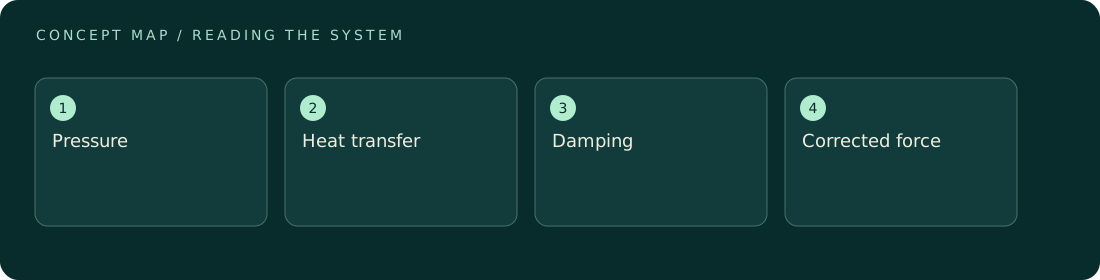
A pressure sweep changes more than the number of gas molecules around a device. It can alter convection, molecular heat transfer, outgassing, mechanical damping, and pressure gradients. A sensor's dynamic response may change even when the applied force does not. Pressure-dependent behavior is therefore diagnostic but not uniquely identifying. Track temperatures, response functions, pumping history, and gauge conditions alongside the force. Compare up and down sweeps after controlled settling to separate equilibrium trends from time-dependent effects and hysteresis.
How to reason about it
At higher pressures, continuum gas behavior may be useful; at sufficiently low pressures, molecular transport becomes important. The transition depends on mean free path relative to geometry rather than pressure alone. Temperature differences between a gauge and a chamber can produce thermal transpiration, so the indicated pressure may require interpretation. Meanwhile, reduced gas damping can raise a mechanical resonance peak, and reduced cooling can increase thermal deformation. A useful sweep protocol holds optical power and alignment constant, measures transfer functions at each state, and waits according to observed thermal and pressure relaxation rather than a fixed arbitrary delay. Repeating selected pressures out of order tests whether the apparent trend is simply drift. A plateau in force is informative only after gauge limits, residual gas composition, and temperature stabilization have been considered. No single functional trend proves a particular microscopic mechanism.
ILLUSTRATIVE · NOT A REPORTED RESULT
An example to work through
In a hypothetical resonant force measurement, pressure reduction increases Q from 20 to 80 while stiffness and the true sinusoidal force remain fixed. Resonant displacement increases fourfold. If the analyst keeps the original displacement-to-force conversion, a constant 2 nN input appears to become 8 nN. Recalibrating the susceptibility at each pressure recovers 2 nN in both cases. This simple calculation assumes one linear mode. Add independent temperature measurements to test whether the actual applied force also changes as cooling conditions change during the sweep.
Where interpretation fails
Do not extrapolate a straight line in pressure across gas-flow regimes or claim that a low-pressure plateau eliminates thermal artifacts. Radiative heating, solid conduction, and some electrostatic effects persist in vacuum. The pressure gauge's reading also need not equal the local pressure at a warm or restricted region.
The next decision
Interpret a sweep only when pressure, temperature, and mechanical response are sufficiently stable at each point and repeated points agree within uncertainty. Use independent perturbations, such as changing gas species or thermal gradients, to distinguish competing explanations. Report the tested range and geometry rather than claiming universal pressure independence.
Sources & context
These sources support the concepts noted below. Our synthetic examples and research framing are educational interpretation; they are not findings from these organizations or validation of our ventures.
- NIST: Pressure and Vacuum Measurements ↗
Further reading on thermal transpiration; search excerpt checked, PDF opened but text extraction unavailable.
Source check: Relevant excerpt or resource metadata checked; see support note. Original illustrative calculation, not source data.
Educational research context, not a validated device specification or clinical protocol. Read our editorial and correction policy.