

The essential answer
Permissions determine which actions particular people or systems may perform. Preservation needs appropriate access as well as protection from inappropriate changes or disclosure. NIST describes identity and access management in terms of suitable access to resources. The conceptual challenge is that storing an object securely does not necessarily make it available to the right future user. Conversely, broad access can expose an archive to changes that undermine trust. Permission design must therefore be understood as part of stewardship.
How to reason about it
Start by separating actions. Viewing, modifying, exporting, deleting, and managing access are different powers, even when an interface places them close together. Then separate identity from authorization: knowing who someone is does not by itself establish what that person may do. A further distinction concerns continuity. An archive can preserve its files while losing the institutional ability to authorize appropriate access when staff or systems change. These are conceptual relationships, not a universal access policy. The right arrangements depend on the resource and its governing obligations. For a reader, the most useful evidence is an explanation of responsibility, the scope of granted actions, and how changes to those responsibilities are documented. A vague claim of secure storage leaves these questions unanswered.
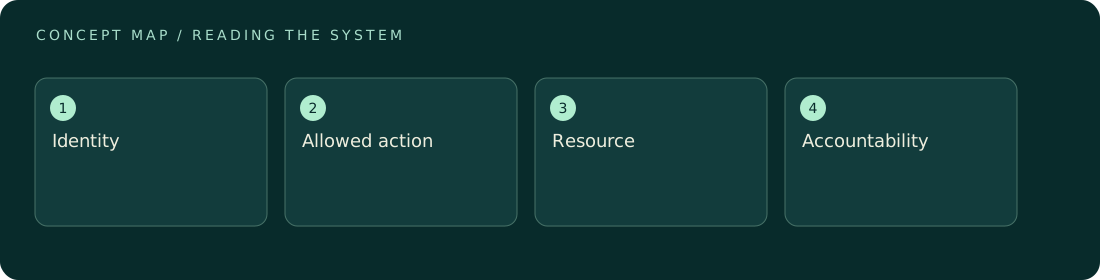
ILLUSTRATIVE · NOT A REPORTED RESULT
An example to work through
Imagine a fictional historical collection with a curator, a researcher, and an administrator. Assume the researcher needs to read a catalog, the curator may correct descriptions, and the administrator manages accounts. Giving everyone the same powers would erase these distinctions. Now imagine the only administrator leaves and no authorized successor is documented. The files may still exist, yet legitimate access decisions become difficult. This example does not prescribe a real institution's roles. It shows how preservation depends on continuity of authority as well as continuity of the stored objects and their technical environment.
Where interpretation fails
Do not treat encryption, login, and authorization as synonyms. Each answers a different question. Also avoid assuming that restricted access is necessarily well-governed access: a resource can be locked away from everyone, including legitimate custodians, while still being described as securely retained.
The next decision
Ask which actions each role can perform and who can legitimately change those permissions. Consider how responsibilities persist through personnel changes. For any real archive, follow its governing policy and responsible authority; this educational framework does not grant access or determine a person's entitlement to use material.
Sources & context
These sources support the concepts noted below. Our synthetic examples and research framing are educational interpretation; they are not findings from these organizations or validation of our ventures.
- Identity and access management ↗
NIST frames identity and access management around appropriate access to resources.
Source check: Official resource overview opened.
Educational research context, not a validated device specification or clinical protocol. Read our editorial and correction policy.