

The essential answer
Evidence about a preserved organ supports claims about that organ within the reported study. It does not automatically establish preservation of an entire organism. A whole organism involves relationships among systems, and a study of one component does not test every relationship. The cited rat-kidney work reports a specific transplantation result. Reading it carefully means preserving that scope, including the model and endpoint, rather than extending its result to a different biological scale or an untested outcome.
How to reason about it
Scope is part of a scientific result, not an optional caveat added afterward. To understand a study, identify the object examined, the conditions under which it was examined, and the outcome used to judge it. Then compare those three items with the claim someone wants to make. If the proposed claim changes from a component to an integrated system, a new inferential step has appeared. That step needs evidence. A useful nonbiological analogy is a tested valve and a complete water network: the valve's performance matters, yet does not settle every question about the network. The analogy explains the logic of scope without asserting that organisms behave like plumbing. Organ studies can be substantial advances while still leaving whole-organism questions unanswered.
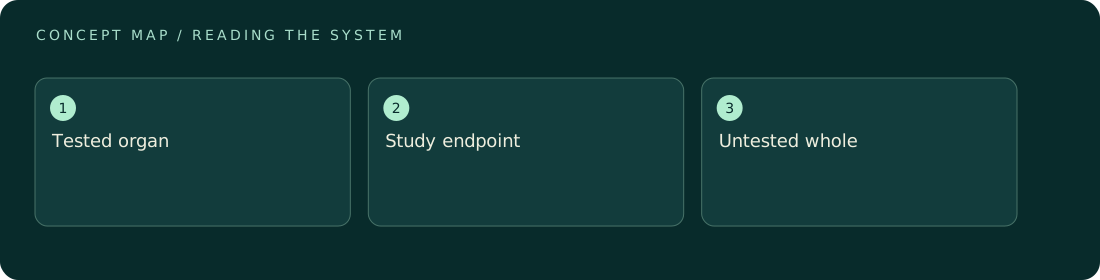
ILLUSTRATIVE · NOT A REPORTED RESULT
An example to work through
Suppose an imaginary research summary describes preserved component R functioning in a supported setting. A headline then says that system R-S-T can be preserved as a unit. Assume the component finding is sound. The headline still adds two untested components and their coordination. A student can mark the original finding in one box and the added claim in another. The blank space between them represents missing evidence, not proof of impossibility. This exercise is about logical boundaries only; the labels do not represent a clinical procedure or a claim about any person's future.
Where interpretation fails
Avoid both exaggeration and dismissal. A component result is not a complete-system result, but it can still be scientifically meaningful. Calling all limited findings irrelevant makes the opposite mistake from treating them as universal. The correct response is to state what the experiment actually resolves.
The next decision
Restate preservation headlines as a three-part sentence: this material, in this model, met this endpoint. If a broader conclusion cannot fit that sentence without changing a term, label it an extrapolation. Do not infer whole-organism recovery or any personal continuity outcome from an organ study.
Sources & context
These sources support the concepts noted below. Our synthetic examples and research framing are educational interpretation; they are not findings from these organizations or validation of our ventures.
- Vitrification and nanowarming enable long-term organ cryopreservation and life-sustaining kidney transplantation in a rat model ↗
The cited work is explicitly a rat kidney transplantation model, not whole-organism preservation.
Source check: Research abstract/search excerpts reviewed; full-text open failed.
Educational research context, not a validated device specification or clinical protocol. Read our editorial and correction policy.