

The essential answer
Acoustic agglomeration concerns sound-induced changes in particle encounters and growth into larger aggregates or droplets. Different particle sizes can respond differently to oscillating air, creating relative motion. A change in size distribution may then influence settling or interception. It does not follow that any speaker clears outdoor fog efficiently. Chamber conditions, acoustic field structure, exposure time, energy use, and the fate of liquid water all matter when interpreting an experimental result or scaling claim.
How to reason about it
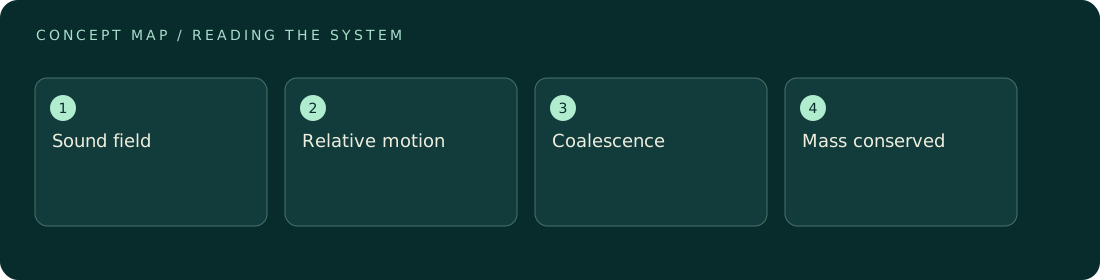
A sound wave supplies an oscillatory disturbance rather than a one-way conveyor. The key question is whether droplets acquire relative trajectories that increase collision and successful coalescence. Even when agglomeration occurs, total liquid mass need not decrease; it may simply move into fewer larger droplets. A number concentration drop is therefore not equivalent to water removal. The cited chamber experiment studies droplet spectra under sound, providing limited experimental context. Outdoor air introduces advection, variable sound fields, boundaries, and changing fog supply. An appropriate conceptual balance tracks droplet number, size, liquid mass, and exiting flow separately. Report acoustic energy over the same interval as any collection benefit. Without that boundary, a visually striking local effect can be mistaken for an efficient water-harvesting or fog-mitigation process.
ILLUSTRATIVE · NOT A REPORTED RESULT
An example to work through
Assume eight identical spherical droplets merge completely into one, with no evaporation or liquid loss. Conservation of volume gives a new diameter equal to the cube root of eight times the original diameter, so diameter doubles. Droplet count decreases by 87.5%, yet total liquid mass stays unchanged. This hypothetical example explains why a particle counter alone cannot demonstrate water removal. It does not predict collision frequency, required sound intensity, or outdoor performance. Those would require a validated physical model and measurements beyond the volume balance.
Where interpretation fails
A fall in droplet count can reflect coalescence, instrument loss, advection, or evaporation. Treating it as proof of harvested water confuses particle number with mass. Laboratory acoustic exposure also cannot be translated directly into a safe or effective outdoor device specification.
The next decision
Look for size-resolved measurements, a liquid mass balance, an untreated comparison, and energy accounting. Keep chamber findings labeled as chamber findings. If the only result is a shift in optical appearance or number concentration, describe that observation precisely and leave removal efficiency unresolved.
Sources & context
These sources support the concepts noted below. Our synthetic examples and research framing are educational interpretation; they are not findings from these organizations or validation of our ventures.
- Interaction between strong sound waves and cloud droplets: Cloud chamber experiment ↗
Chamber study of sound and droplet-size spectra; no outdoor efficacy inferred.
Source check: Search-result abstract or official excerpt reviewed; full paper methods not audited
Educational research context, not a validated device specification or clinical protocol. Read our editorial and correction policy.