

The essential answer
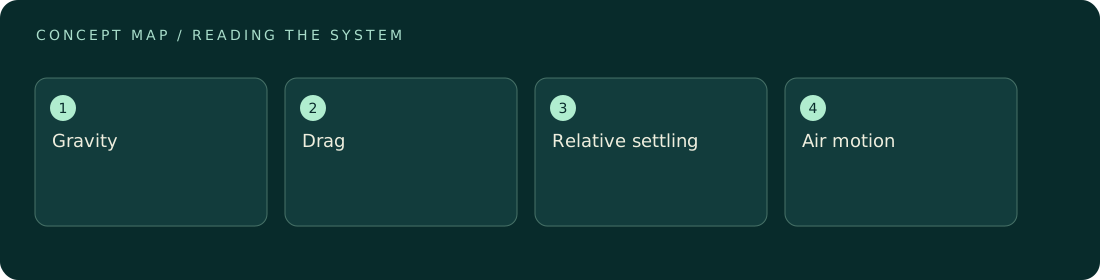
A droplet settles when gravity produces downward motion relative to the surrounding air. Terminal settling means drag balances the effective weight, not that the droplet is motionless relative to the ground. Small droplets can have slow settling speeds, so modest vertical air motion may dominate their ground-relative trajectory. A settling estimate is therefore useful only with the drag regime, droplet diameter, air properties, and observation time stated. It is not a complete model of fog persistence.
How to reason about it
For a small spherical droplet in the low-Reynolds-number limit, Stokes drag gives terminal speed proportional to diameter squared. The proportionality includes density difference, gravity, and air viscosity. Doubling diameter then increases predicted settling speed fourfold, provided the same approximation remains valid. Evaporation, turbulence, interactions, and non-Stokes drag can invalidate a simple trajectory estimate. NASA's treatment of terminal motion supplies the general force-balance context; the specific low-speed example below is an idealized calculation. Distinguish velocity relative to air from velocity relative to ground by adding the local air motion with a consistent sign convention. In a collector, compare the settling distance over the transit time with the device dimensions. A mathematically nonzero settling speed may still produce negligible displacement during a short encounter.
ILLUSTRATIVE · NOT A REPORTED RESULT
An example to work through
Assume a 10-micrometer spherical water droplet, density difference of 1,000 kilograms per cubic meter, gravity of 9.81 meters per second squared, and air viscosity of 1.8 times 10^-5 pascal seconds. The Stokes estimate is density difference times gravity times diameter squared divided by eighteen times viscosity: approximately 0.00303 meters per second. In ten seconds it falls about 3.0 centimeters relative to still air. An upward air velocity of 0.01 meters per second would exceed this settling speed in the simplified model.
Where interpretation fails
Using a large raindrop's fall speed for a fog droplet can create a major error. Conversely, extending Stokes law to all diameters ignores its flow-regime limit. A settling calculation also cannot decide whether a droplet evaporates before it reaches the surface.
The next decision
Use a settling model as one term in a trajectory budget. Check its regime, compare air motion and residence time, and label omitted evaporation or turbulence. If those omissions dominate the expected displacement, prefer a conditional range over a single predicted landing location.
Sources & context
These sources support the concepts noted below. Our synthetic examples and research framing are educational interpretation; they are not findings from these organizations or validation of our ventures.
- NASA: Flight equations with drag ↗
General terminal-velocity force balance; original Stokes-law worked example.
Source check: Search-result abstract or official excerpt reviewed; full paper methods not audited
Educational research context, not a validated device specification or clinical protocol. Read our editorial and correction policy.