

The essential answer
An electric field can exert a force on a charged droplet, but force alone does not establish collection. Charge magnitude, field direction, aerodynamic drag, droplet size, and time spent in the active region determine whether the trajectory changes enough to reach a surface. Neutral polarizable droplets involve a different force model, especially in nonuniform fields. A defensible explanation separates charging, motion, contact, and drainage instead of assuming that a higher voltage guarantees more recovered water.
How to reason about it
The simplest charged-particle relation is force equals charge times electric field. It tells you the immediate electrical force for a known charge and local field. It does not provide the charge distribution, the field geometry, or the opposing drag. Real droplets may carry different charges, and electric fields can vary sharply across a collector. Residence time then matters: a sideways force applied briefly may produce little displacement before a droplet exits. The cited experiment used space-charge injection to influence fog collection, supporting the mechanism rather than a universal performance number. For educational analysis, compare a charged-droplet model with an uncharged control and include all electrical inputs in the energy boundary. Avoid inferring charge from an applied voltage alone; those variables describe different parts of the physical system.
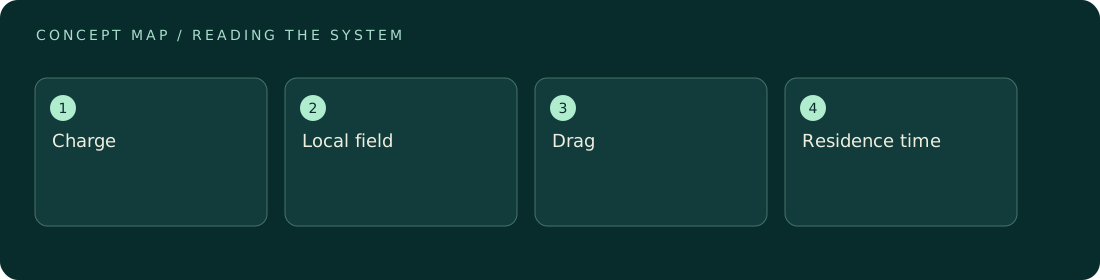
ILLUSTRATIVE · NOT A REPORTED RESULT
An example to work through
Assume a hypothetical droplet carries 2 femtocoulombs and experiences a uniform field of 100,000 volts per meter. Using 1 femtocoulomb equal to 10^-15 coulombs, electrical force is 2 times 10^-15 times 10^5, or 2 times 10^-10 newtons. This arithmetic does not predict its displacement because drag and exposure time have not been specified. Reversing the charge sign reverses the force direction in the same field. These values are a conceptual calculation, not a construction specification or a measured collection result.
Where interpretation fails
Applied voltage is not electric field without a geometry model, and electric field is not droplet charge. Combining the three as interchangeable indicators hides the actual mechanism. Also, a visible change in droplet trajectories may not translate into drained water if the surface retains the liquid.
The next decision
Ask which force law is being used and which quantities were measured. Report collection and energy outcomes separately from trajectory evidence. When charge or field maps are missing, keep the conclusion qualitative: the mechanism may be plausible, but the numerical collection prediction remains underdetermined.
Sources & context
These sources support the concepts noted below. Our synthetic examples and research framing are educational interpretation; they are not findings from these organizations or validation of our ventures.
- Electrostatically driven fog collection using space charge injection ↗
Experimental charging and electric-field-assisted fog collection; abstract evidence only.
Source check: Search-result abstract or official excerpt reviewed; full paper methods not audited
Educational research context, not a validated device specification or clinical protocol. Read our editorial and correction policy.