

The essential answer
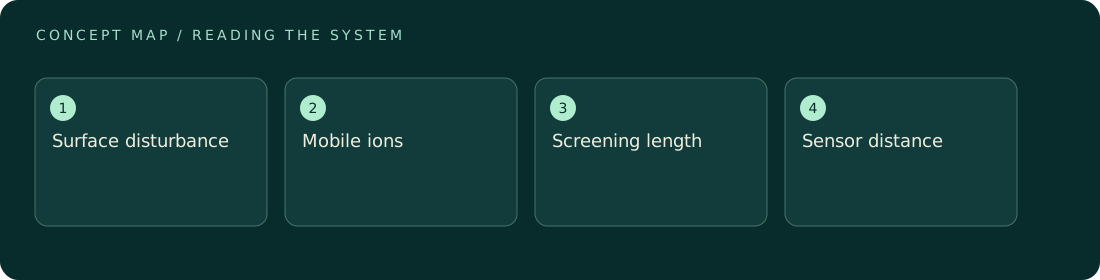
Debye screening describes how mobile ions in an electrolyte reduce the reach of an electrostatic disturbance. The screening length depends on solution conditions and the model's assumptions. A short screening length can constrain electrical sensing near a surface, but it does not imply that cells have no membrane voltage or that electrical currents cannot flow through an electrolyte. Keep these physical questions separate. Screening is a spatial response of ions, not a blanket prohibition on bioelectric phenomena.
How to reason about it
In a simple linearized model, potential from a planar disturbance decays exponentially with distance over a characteristic length. This approximation is useful for reasoning about whether a sensor is close enough to detect a local charge-related signal. Real interfaces may involve geometry, membranes, specific ion interactions, and nonlinear effects that require a richer treatment. The cited supported-lipid-membrane transistor study addresses screening in a particular sensing architecture. It does not establish a universal range for every biological electrical interaction. For original interpretation, identify the source of the field, the medium carrying the ions, the location of the detector, and the relevant timescale. A membrane potential refers to a voltage across a membrane boundary; a screened extracellular perturbation is a different spatial problem. Treating them as identical creates an apparent contradiction that the definitions themselves resolve.
ILLUSTRATIVE · NOT A REPORTED RESULT
An example to work through
Assume an idealized potential decays as its surface value times exp(-distance divided by screening length). At one screening length, about 36.8% remains; at three lengths, about 5.0% remains. If the assumed length is 1 nanometer, those positions are 1 and 3 nanometers from the reference surface. These are model outputs, not measurements of a particular cell or solution. They show why sensor distance matters, while leaving membrane transport, dynamic currents, and nonlinear interfacial behavior outside this deliberately simplified educational calculation.
Where interpretation fails
A nanometer-scale screening estimate does not prove that all electric-field effects in biology are impossible. Conversely, observing a biological response does not justify ignoring screening. Both errors skip the geometry, boundary conditions, frequency, and physical mechanism that determine which model applies.
The next decision
Use a screening calculation only after identifying its medium and boundary assumptions. Distinguish local charge sensing from transmembrane voltage and bulk conduction. If a proposed mechanism crosses those categories, request a model that explicitly connects them rather than relying on a single screening-length number.
Sources & context
These sources support the concepts noted below. Our synthetic examples and research framing are educational interpretation; they are not findings from these organizations or validation of our ventures.
- Ionic contrast across a lipid membrane for Debye length extension ↗
Debye-screening constraints in a specific bioelectronic sensing architecture.
Source check: Search-result abstract or official excerpt reviewed; full paper methods not audited
Educational research context, not a validated device specification or clinical protocol. Read our editorial and correction policy.