

The essential answer
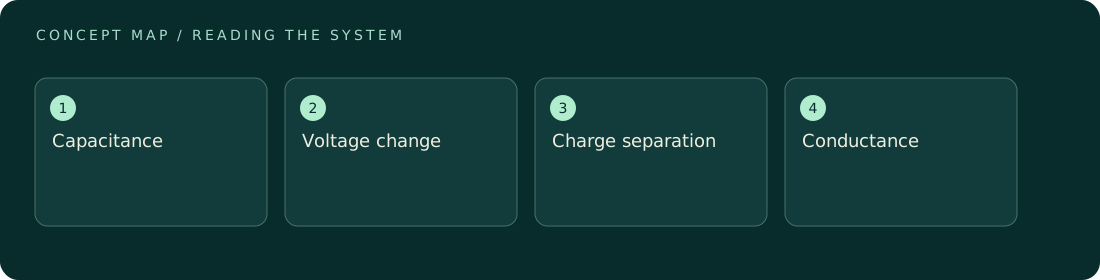
Membrane capacitance describes how much charge separation corresponds to a change in voltage across a membrane. In a simple linear model, charge change equals capacitance times voltage change. This does not mean the entire cell behaves as an ideal capacitor under every condition. Ion conductance, membrane geometry, and measurement frequency can matter. Use capacitance to organize electrical bookkeeping, then state which biological features the model represents and which remain outside its scope.
How to reason about it
A capacitor model treats the membrane as an insulating layer separating conductive compartments. Total capacitance depends on geometry as well as material properties, so a larger value can reflect greater electrically accessible membrane area rather than a change in intrinsic membrane quality. Conductance describes a different process: current crossing the membrane through conductive pathways. Combining these elements produces time-dependent behavior, but a single capacitance value cannot identify all underlying channels or cellular states. The cited optical-electrical study uses the charge-voltage relation in its analysis. The example below is an original idealized calculation, not a measured cell result. When comparing cells, ask whether total capacitance or capacitance per area is reported, and whether the acquisition model separates capacitive and conductive components sufficiently for the stated interpretation.
ILLUSTRATIVE · NOT A REPORTED RESULT
An example to work through
Assume a hypothetical membrane has constant total capacitance of 10 picofarads and experiences a 20-millivolt voltage change. Charge change is 10 times 10^-12 farads multiplied by 20 times 10^-3 volts, or 2 times 10^-13 coulombs. That equals 0.2 picocoulombs. Doubling capacitance at the same voltage change doubles the required charge separation. The model assumes linear capacitance and does not specify the ions involved, the rate of charging, or whether the hypothetical cell's specialized biological function changes as a direct result.
Where interpretation fails
Capacitance, membrane voltage, and membrane resistance are different quantities. A higher capacitance cannot be interpreted as more electrical activity without additional context. Normalizing current by capacitance can be useful, but it also embeds assumptions about what capacitance represents across the compared cells.
The next decision
State the circuit approximation, units, and whether values are total or area-normalized. Use the charge-voltage equation for bookkeeping, not as a health score. If a biological conclusion depends on membrane area or channel activity, identify the separate evidence supporting those interpretations.
Sources & context
These sources support the concepts noted below. Our synthetic examples and research framing are educational interpretation; they are not findings from these organizations or validation of our ventures.
- Membrane water for probing neuronal membrane potentials and ionic fluxes ↗
Use of membrane capacitance and charge-voltage relation.
Source check: Search-result abstract or official excerpt reviewed; full paper methods not audited
Educational research context, not a validated device specification or clinical protocol. Read our editorial and correction policy.