

The essential answer
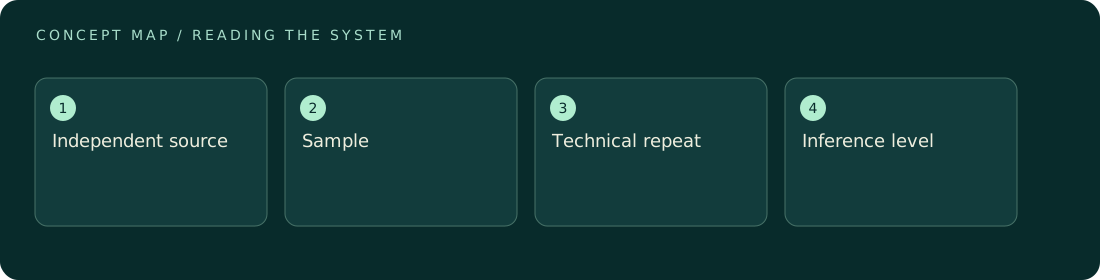
Technical replicates repeat measurement or processing of the same underlying biological material. They help characterize technical variability but do not automatically create independent biological evidence. Biological replication concerns independently sampled units relevant to the question, such as donors or separately established cultures. The correct unit depends on the design. Report both levels and their relationships; counting every well or cell as an independent replicate can make uncertainty look smaller than the evidence warrants.
How to reason about it
A nested design has multiple observations within a higher-level unit. Those observations may share donor, preparation, environment, or processing effects, so they are correlated. The cited pseudoreplication study shows why treating cells as independent when the comparison concerns individuals can distort inference. For an original interpretation, draw the hierarchy before calculating sample size: donor, preparation, well, image, cell, and repeated reading may all be different levels. Technical repeats can reveal whether an assay is noisy, while independent biological units address variability in the population of interest. Averaging technical repeats within a unit may be appropriate for some summaries, but analysis should match the estimand and design. A very large number of cell measurements cannot compensate automatically for having only one independently sampled source in each comparison group.
ILLUSTRATIVE · NOT A REPORTED RESULT
An example to work through
Assume three independent donors each contribute one sample, and each sample is read four times. There are 12 instrument readings but only three donor-level units. If the question concerns variation across donors, reporting n equals 12 independent donors would be incorrect. The four readings can improve the estimate for each donor and help assess technical spread. This hypothetical example does not prescribe a statistical test; it identifies the hierarchy that any analysis must respect before confidence intervals or significance claims are calculated.
Where interpretation fails
A small standard error across many readings can reflect repeated measurement of the same material rather than broad biological consistency. Calling wells biological replicates without describing their origin can hide shared preparation effects. Labels alone do not establish independence; the sampling process does.
The next decision
Report the number of independent units at every relevant level and explain which level supports the inference. Use technical repeats to assess measurement reliability. If biological replication is limited, state that limitation directly rather than inflating sample size with nested cells, images, or repeated readings.
Sources & context
These sources support the concepts noted below. Our synthetic examples and research framing are educational interpretation; they are not findings from these organizations or validation of our ventures.
- A practical solution to pseudoreplication bias in single-cell studies ↗
Primary analysis of pseudoreplication and inter-individual dependence.
Source check: Search-result abstract or official excerpt reviewed; full paper methods not audited
Educational research context, not a validated device specification or clinical protocol. Read our editorial and correction policy.