

The essential answer
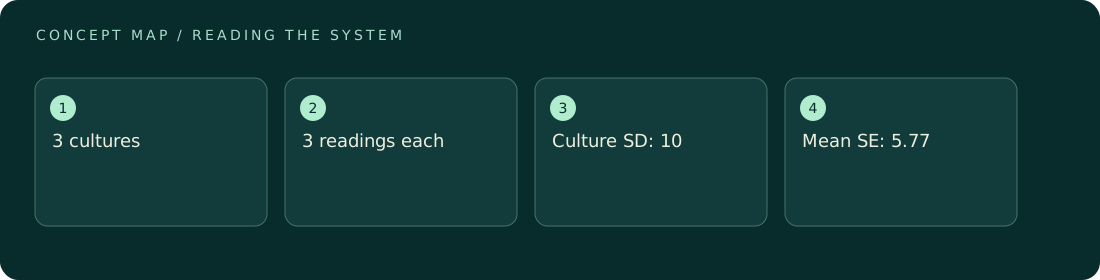
Three illustrative independent cultures have mean responses 90, 100, and 110 units. Their mean is 100 and their sample standard deviation is 10. The standard error across cultures is 10/√3=5.77 units. Measuring each culture three times can characterize reading noise, but it does not turn three biological units into nine. Treating every technical reading as independent would understate uncertainty about the culture population in this constructed example.
How to reason about it
A hierarchical measurement model separates variation between cultures from variation among readings of the same culture. Technical repeats share the culture's biology and preparation history, so their errors are correlated through that common unit. The appropriate analysis depends on the question: instrument repeatability may use technical readings, while inference about independent cultures needs between-culture replication or an explicit hierarchical model. A sample variance uses squared deviations and a denominator reflecting estimated parameters. Unequal variance between conditions may require further modeling; the cited statistical methods page explains why variance assumptions deserve attention. The example does not perform a biological significance test. Its purpose is to show how changing the assumed independence structure changes a standard error even when the list of numbers stays fixed.
ILLUSTRATIVE · NOT A REPORTED RESULT
An example to work through
Use illustrative readings (89,90,91), (99,100,101), and (109,110,111), with each triplet belonging to one independent culture. Each triplet mean is respectively 90, 100, and 110. The grand mean is 100. Between-culture sample variance is [(90−100)²+0²+(110−100)²]/(3−1)=200/2=100 units². Thus s=10 and the standard error of the culture mean is 10/√3=5.7735 units. Within every culture, sample variance is (1+0+1)/2=1 unit². If all nine values are incorrectly treated as independent, their sum of squared deviations from 100 is 606 units². That gives sample variance 606/8=75.75 and a naive standard error sqrt(75.75)/3=2.90115 units. The smaller number is produced by the wrong sampling model, not by discovering more independent biology. Averaging technical readings first is transparent here; a hierarchical analysis can retain individual readings while modeling their shared culture membership.
Where interpretation fails
A large number of wells or images is not automatically a large biological sample. Wells derived from one preparation can share important variation. On the other hand, discarding technical variation entirely can hide poor measurement quality. Record both levels and avoid presenting the total read count as the independent sample size.
The next decision
Identify the unit that was independently sampled or assigned to a condition, then compute uncertainty at that level. For the illustrative question about cultures, report three independent units and the 5.77-unit standard error. Keep technical repeatability as a separate descriptive quantity and avoid claiming precise population inference from three cultures.
Sources & context
These sources support the concepts noted below. Our synthetic examples and research framing are educational interpretation; they are not findings from these organizations or validation of our ventures.
- NIST: Levene Test for Equality of Variances ↗
Variance assumptions require explicit attention.
Source check: Official statistical methods page read
Educational research context, not a validated device specification or clinical protocol. Read our editorial and correction policy.