
The essential answer
Choose instrumentation by asking whether the complete measurement chain can resolve the decision under actual operating conditions. Display resolution is only one property. Range, bandwidth, uncertainty, drift, sensor loading, calibration, and installation can all control usefulness. Define the quantity and required evidence first, then select a sensor, acquisition system, and analysis procedure together. A technically impressive instrument may be unsuitable if it disturbs the system, misses the transient, or has poorly characterized behavior in the environment where the measurement will be made.
How to reason about it
Translate the engineering question into an expected signal range and a tolerable uncertainty contribution. Check both the smallest meaningful change and the largest plausible excursion so sensitivity is not purchased at the cost of saturation. For transient work, consider sensor dynamics, sampling, filtering, and synchronization as a chain; a fast digitizer cannot restore a slow sensor's lost response. Evaluate mounting and loading because the sensor may alter heat flow, stiffness, electrical impedance, or fluid behavior. Calibration should cover the relevant range and conditions, with a plan for drift checks during the campaign. Assess whether common environmental effects correlate multiple channels. Finally, test the proposed chain on a known input or reference condition before relying on it for acceptance. The useful specification is the uncertainty and response of the installed measurement process, not just a catalogue number for the sensing element.
ILLUSTRATIVE · NOT A REPORTED RESULT
An example to work through
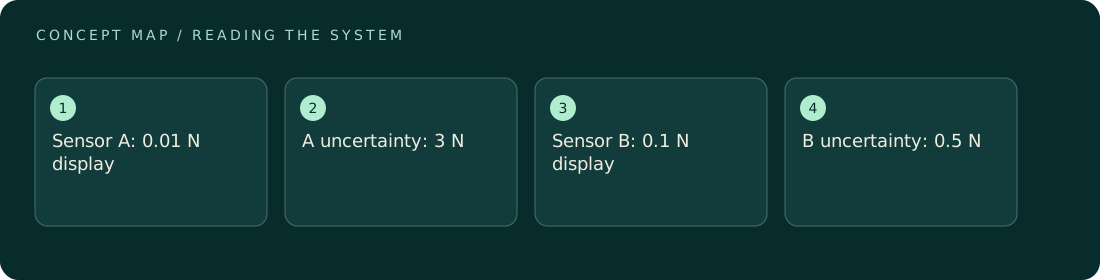
Suppose a fictional force test must distinguish a 100 N response from a 102 N limit. Sensor A displays 0.01 N increments but its installed expanded uncertainty is 3 N. Sensor B displays 0.1 N increments with an installed expanded uncertainty of 0.5 N. Under a simple accept-if-reading-plus-uncertainty-is-below-limit rule, a 100 N reading from A gives 103 N and cannot establish acceptance. The same reading from B gives 100.5 N and can. Assuming adequate range and bandwidth for both, B better serves this decision despite its coarser display. These assumed uncertainties are illustrative, not product specifications.
Where interpretation fails
More displayed digits do not establish more accurate information. Quoted sensor accuracy can exclude mounting, acquisition, temperature, and calibration effects that dominate the installed system. Likewise, choosing a sampling frequency solely from the signal's nominal repetition rate can miss short transients or unwanted high-frequency content.
The next decision
Select the least burdensome measurement chain that meets the required uncertainty and dynamic response with documented margin. If no available chain can distinguish the acceptance boundary, revise the test method or acknowledge an inconclusive outcome. Confirm installed performance before the main test and retain calibration and configuration records with the results.
Sources & context
These sources support the concepts noted below. Our synthetic examples and research framing are educational interpretation; they are not findings from these organizations or validation of our ventures.
- NIST: Measurement Process Characterization ↗
Measurement characterization considers bias, variability, and reference bases.
Source check: Official handbook overview opened; linked-topic outline inspected.
Educational research context, not a validated device specification or clinical protocol. Read our editorial and correction policy.