

The essential answer
An epigenetic clock combines molecular measurements into an estimated age or related score. The output depends on the model and the population used to develop it. A lower clock estimate does not automatically mean better function, reversal of every aging process, or a benefit to a person. In cultured cells, assess whether the clock is appropriate for the cell type and conditions, then compare it with independent endpoints rather than treating it as a comprehensive verdict.
How to reason about it
A prediction model learns relationships in its training data. When applied to a new context, changes in cell composition, measurement platform, or biological state may affect interpretation. The cited primary study distinguishes epigenetic aging from several other cellular aging features, supporting the need to keep endpoints separate. For original reasoning, imagine a dashboard with clock estimate, viable-cell count, identity, and a predefined function. Agreement among them is informative, but disagreement is also a result rather than a nuisance to hide. Measurement uncertainty matters especially when the observed shift is small. Report which clock was used, its applicability, and the comparison design. A model output expressed in years does not make an in vitro change equivalent to years of human lifespan gained, nor does it establish the safety of whatever condition accompanied the change.
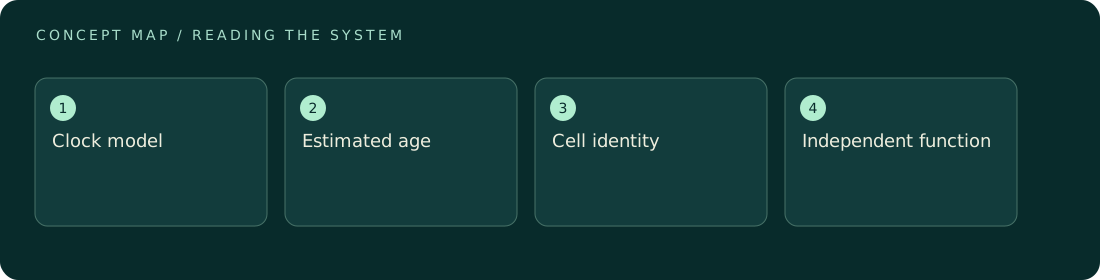
ILLUSTRATIVE · NOT A REPORTED RESULT
An example to work through
Assume a hypothetical clock gives values of 40 and 36 model-years before and after a culture comparison, while a predefined functional readout falls from 100 to 80 units. The clock estimate decreases by 4 model-years, and function decreases by 20%. The data therefore do not support a blanket improvement claim. This example assumes the values are comparable but deliberately leaves measurement uncertainty unspecified; without it, even the reliability of the clock shift remains unresolved. No conversion to human lifespan or clinical benefit is justified.
Where interpretation fails
Selecting whichever clock moves in the preferred direction after inspecting results creates a biased narrative. Another error treats predicted age as a direct physical measurement of all aging mechanisms. Keep model choice, assay variability, and independent outcomes visible rather than reporting only a favorable number.
The next decision
Choose the clock and functional endpoints before interpreting the comparison. Report uncertainty, cell composition, and any disagreement across measures. Describe a clock shift as a clock shift until independent evidence supports a broader biological claim, and keep cultured-cell findings distinct from human efficacy.
Sources & context
These sources support the concepts noted below. Our synthetic examples and research framing are educational interpretation; they are not findings from these organizations or validation of our ventures.
- The relationship between epigenetic age and the hallmarks of aging in human cells ↗
Primary study separating epigenetic aging from other cellular hallmarks.
Source check: Article abstract and introductory findings reviewed
Educational research context, not a validated device specification or clinical protocol. Read our editorial and correction policy.