

The essential answer
Agreement between independent solvers is useful verification evidence when they solve the same well-specified mathematical problem using genuinely different implementations or numerical methods. It is stronger when each solution has its own convergence assessment and when an analytic or manufactured reference is also available. Agreement alone does not prove correctness: both solvers may share an input error, an approximation, or a mistaken boundary condition. Treat comparison as a way to expose discrepancies and narrow uncertainty, not as a vote that determines the truth.
How to reason about it
Define a common benchmark precisely, including equations, constants, geometry, initial and boundary conditions, and the observable to compare. Establish compatible units and extraction locations before looking at results. Then refine each solver independently so its numerical error is small enough for the comparison to be meaningful. If implementations share a mesh generator, library, or constitutive routine, record that dependency because it limits independence. Start with simple cases that isolate one mechanism and have known behavior, then increase complexity. When results disagree, preserve the disagreement rather than averaging it away. Compare intermediate fields, boundary fluxes, and conservation balances to locate the source. A solver comparison belongs within a wider evidence chain that includes code tests, numerical convergence, and experimental validation for the intended physical use. Different software names alone do not guarantee different failure modes or assumptions.
ILLUSTRATIVE · NOT A REPORTED RESULT
An example to work through
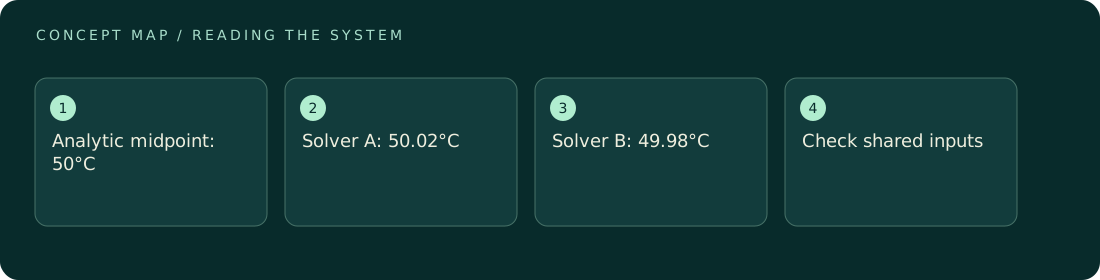
Consider an ideal one-dimensional bar with fixed end temperatures and constant conductivity. A hand calculation predicts a linear profile with midpoint temperature 50 degrees Celsius. Solver A reports 50.02 and solver B 49.98 after separate refinement studies estimate errors below 0.03 degrees. The 0.04-degree difference is compatible with those illustrative numerical bounds. Now suppose both had instead imposed the wrong cold-end temperature; they could agree closely with each other while solving the wrong experiment. The diagnostic value comes from the independently specified reference and controlled numerical errors, not from the mere presence of two matching program outputs.
Where interpretation fails
Two front ends around the same numerical library may provide less independence than expected. Copying the same input file can also copy an error into both workflows. Avoid declaring validation from code agreement: experimental representation remains a separate question even when the mathematical problem is solved consistently.
The next decision
Use independent solvers when a consequential result lacks a convenient exact solution or when implementation errors are plausible. Require documented independence and individual convergence evidence. If disagreement exceeds estimated numerical uncertainty, investigate before averaging or selecting the preferred answer. If they agree, state precisely which shared mathematical problem was corroborated.
Sources & context
These sources support the concepts noted below. Our synthetic examples and research framing are educational interpretation; they are not findings from these organizations or validation of our ventures.
- NASA: Verification Assessment ↗
Consistency, temporal convergence, and independent numerical methods are verification checks.
Source check: Official tutorial opened; verification process inspected.
Educational research context, not a validated device specification or clinical protocol. Read our editorial and correction policy.